In contemporary discussions surrounding neurodiversity, the notion of “masking” among autistic adults emerges repeatedly, often accompanied by a profound curiosity and concern. Masking, in this context, refers to the complex and frequently subconscious act of camouflaging or suppressing innate autistic traits to conform to societal expectations. This behavior, so ubiquitous yet so subtle, frequently occurs without explicit realization. It raises critical questions about why so many autistic individuals, especially adults, engage in this phenomenon often unknowingly and what deeper psychosocial dynamics underpin this proclivity. Understanding this intricate interplay sheds light on the nuanced lived experiences of autistic adults and challenges simplistic interpretations.
Understanding the Phenomenon of Masking
Masking is not merely an act of conscious gameplay or deception; for many autistic adults, it is a survival mechanism ingrained over years of social conditioning. From an early age, individuals on the spectrum learn, often implicitly, that their natural ways of interacting, communicating, and perceiving the world may invite misunderstanding, exclusion, or even outright stigma. The resulting pressure fuels a gradual internalized compulsion to “mask” or override these instinctual behaviors.
The subtlety lies in the fact that this masking often happens on an almost automatic level. It may involve suppressing repetitive behaviors, mimicking others’ facial expressions, or modulating vocal tone and body language to mirror neurotypical norms. Over time, these behaviors become so habitual that the individual is scarcely conscious of having slipped into this masked persona—a seamless, yet exhaustive, adaptive performance.
The Role of Social Conditioning and Early Experiences
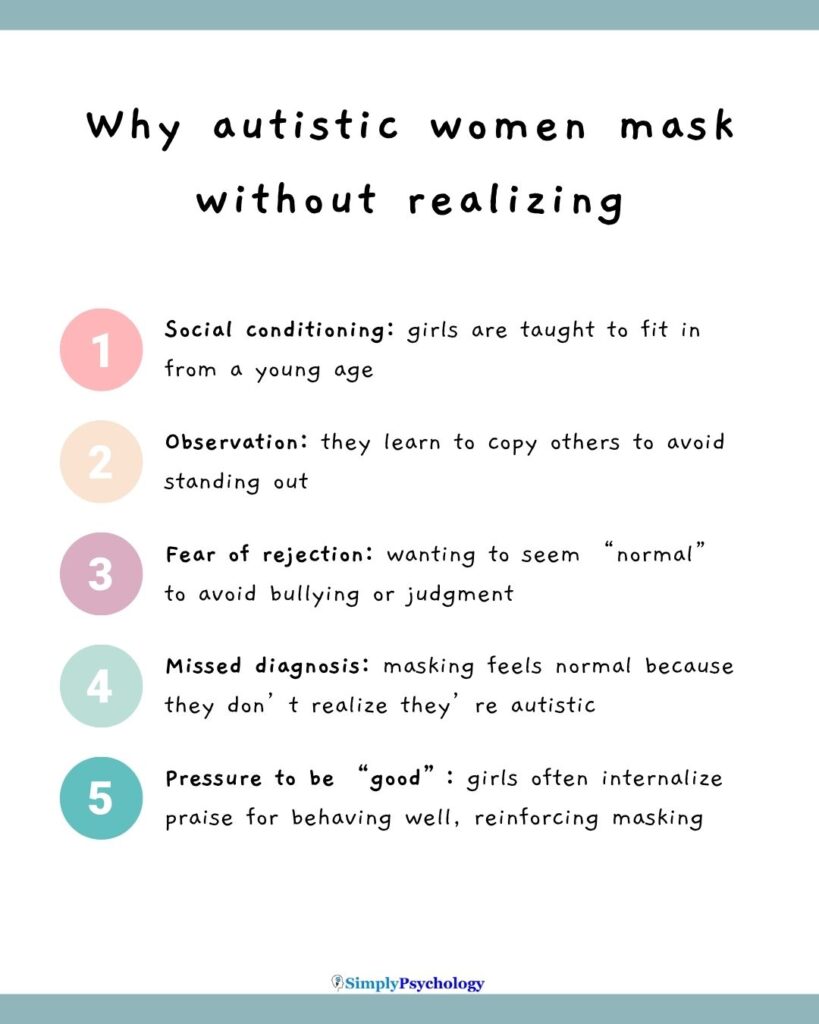
The impetus to mask is frequently rooted in formative social experiences. Children and adults alike receive explicit and implicit cues about normalcy and acceptability—criteria that autism-specific behaviors often fail to meet. This societal template, laden with unwritten rules, propagates a powerful impetus to conceal divergence.
For many autistic adults, early social interactions involve a barrage of subtle rejections or corrective feedback. Perhaps it is an admonition to stop rocking or complaints about atypical eye contact. Often, these signals are not recognized explicitly as cues to mask but rather processed as a nebulous sense of “something being wrong.” As the accumulation of these experiences intensifies, so does the internal resolve to mask, perpetuating a cycle that can persist well into adulthood without conscious awareness.
Psychological and Emotional Costs of Unconscious Masking
While masking can facilitate short-term acceptance or functional social engagement, it imposes a considerable psychological toll. Engaging in constant self-monitoring and behavioral inhibition requires immense cognitive energy. This persistent performance not only engenders emotional exhaustion but also furthers a dissonance between one’s authentic self and the persona presented publicly.
Many autistic adults describe a profound sense of disconnection and fatigue, often referred to as “autistic burnout.” This phenomenon is characterized by overwhelming exhaustion, increased sensory sensitivity, and negative impacts on mental health, including anxiety and depression. Importantly, because masking is often unconscious, individuals may struggle to pinpoint the precise source of their distress, which complicates pathways to support and self-understanding.

The Invisible Nature of Masking: Why It Often Goes Unrecognized
One of the paramount enigmas is why masking frequently unfolds beneath the threshold of conscious recognition. This invisibility serves as both shield and shackle. On the one hand, a lack of conscious awareness can protect the individual from confronting difficult emotions or social exclusion directly. On the other, it obscures the path to self-acceptance and authentic living.
Neuroscientifically, masking may involve the recruitment of executive functions, such as inhibitory control and working memory, which operate as subconscious regulators of behavior. As these cognitive processes become more refined through repeated practice, the masked persona crystallizes into an almost reflexive state, steering social interactions without deliberate mental effort.
Moreover, the pervasive societal valorization of conformity and “passing” as neurotypical catalyzes this invisibility. Many autistic adults report that their masking efforts are so effective that others remain unaware of their diagnosis, which can be both protective and profoundly isolating.
The Cultural and Gendered Dimensions of Masking
The proclivity toward masking is not uniformly distributed across all autistic adults. Notably, research and anecdotal evidence suggest that autistic women and non-binary individuals often mask more extensively than their male counterparts. Cultural expectations around gender roles and social presentation inject an additional layer of complexity.
Women, in particular, may face heightened pressure to exhibit social grace, emotional attunement, and communicative subtlety. As a result, many autistic women develop highly sophisticated masking strategies that enable them to navigate social landscapes with greater apparent ease, even while experiencing profound internal struggles. This dynamic contributes to underdiagnosis, delayed diagnosis, and misinterpretation of autistic traits in females.

Toward Greater Awareness and Authenticity
Recognizing the often unconscious nature of masking is pivotal in cultivating compassionate support systems for autistic adults. Providing safe spaces in which individuals feel valued for their authentic selves can alleviate the impetus to mask. Such environments promote psychological well-being and counteract the isolating effects of chronic camouflaging.
Self-reflection, psychoeducation, and community validation also play integral roles in fostering greater awareness among autistic adults. When individuals gain insight into their own masking tendencies, they can begin to reclaim their identities and negotiate social contexts more intentionally. This process, though challenging, offers a pathway toward diminished exhaustion and enriched self-acceptance.
Conclusion
The phenomenon of autistic masking transcends simple behavioral adaptation, weaving into the very fabric of identity, survival, and societal interaction. Often enacted without conscious awareness, masking emerges as an intricate psychological response to a neurotypically dominated world that prizes conformity. Its unconscious nature elucidates why so many autistic adults find themselves caught in a relentless, invisible performance—one that exacts a heavy emotional and cognitive price.
By illuminating the multifaceted drivers of unconscious masking and its consequences, it is possible to foster a deeper understanding of autistic lived experiences. Encouraging authenticity, reducing social stigma, and reshaping societal attitudes remain imperative to dismantling the veil of invisibility that surrounds masking. In doing so, we honor the rich diversity of neurotypes and support autistic adults in embracing their true selves fully and unapologetically.