Have you ever wondered how two people, each wired differently, can weave their lives into a tapestry of love and resilience? Imagine standing at the threshold of marriage, hearts alight with promise, only to realize that one of you navigates the world through the lens of autism—a spectrum of brilliance, nuance, and occasional missteps. What if I told you that such a relationship isn’t just survivable, but can flourish in ways you never anticipated?
My journey into marriage with a partner on the autism spectrum began with a revelation: love, in its purest form, is not about sameness but about understanding. It’s about recognizing that the way your partner expresses affection might not mirror your own, yet it is no less profound. This realization, though daunting at first, became the cornerstone of a relationship that grew deeper with each challenge overcome. Let’s explore how embracing neurodiversity transformed my marriage into a sanctuary of mutual growth, patience, and unexpected joy.
The First Hurdle: Decoding the Unspoken
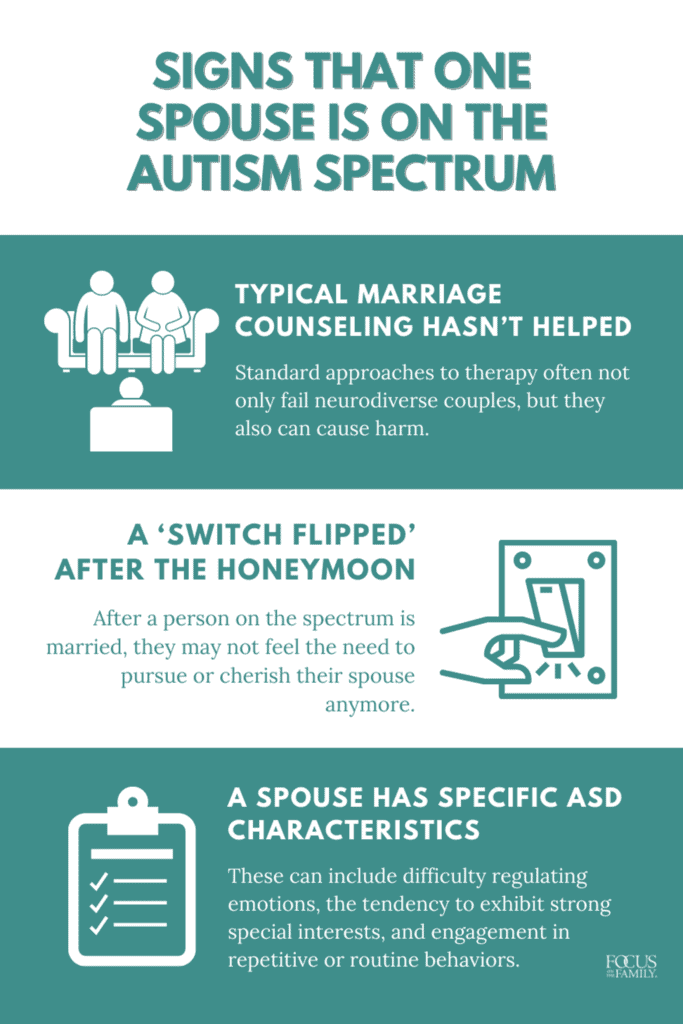
Marriage, at its core, is a dance of communication. But what happens when one partner’s steps are choreographed differently? Autism often manifests in subtle, sometimes baffling ways—directness that borders on bluntness, a preference for routine that borders on rigidity, or an emotional reserve that can feel like a fortress. Early on, I misinterpreted these traits as indifference or disinterest. A dismissive shrug wasn’t apathy; it was a coping mechanism. A blunt remark wasn’t cruelty; it was a lack of social filter.
Learning to read between the lines required patience and a willingness to ask questions without judgment. I began to see my partner’s world not as a puzzle to solve but as a landscape to explore. Small gestures, like leaving notes instead of expecting verbal affirmations, became bridges between our differing communication styles. The key wasn’t to change my partner but to adapt my expectations, transforming frustration into curiosity.

The Art of Compromise: Finding Middle Ground
Every marriage demands compromise, but neurodiverse unions often require a more deliberate, creative approach. Routines, for instance, aren’t just preferences; they’re lifelines. A sudden change in plans isn’t just an inconvenience; it’s a disruption that can trigger anxiety. I learned to balance my spontaneity with my partner’s need for predictability by introducing small, controlled variables—like choosing restaurants with predictable menus or planning outings during off-peak hours.
Yet, compromise isn’t a one-way street. My partner, in turn, began to stretch beyond their comfort zone. They started initiating conversations about emotions, even if it felt like pulling teeth at first. They experimented with social outings, not because they enjoyed them, but because they loved seeing me happy. These concessions weren’t sacrifices; they were acts of devotion, each one a testament to the mutual respect that underpins our relationship.
Love in Unexpected Forms
Affection, too, takes on new shapes in a neurodiverse marriage. For my partner, love isn’t always expressed through words or touch. Sometimes, it’s in the meticulous way they organize the kitchen, ensuring everything has its place. Other times, it’s in the quiet pride they take in my achievements, even if they struggle to articulate it. Recognizing these unconventional expressions of love required me to shed my preconceived notions of what romance should look like.
I discovered that love, in its truest form, is about meeting your partner where they are. It’s about celebrating their strengths—their hyperfocus on passions, their unwavering honesty, their ability to see the world through a unique lens—and gently guiding them through their challenges. It’s about creating a safe space where they can be themselves without fear of judgment, and in doing so, allowing yourself to be truly known as well.
The Role of Patience: A Virtue Tested and Tempered
Patience isn’t just a virtue in a neurodiverse marriage; it’s a lifeline. There were moments when my partner’s literal interpretation of language led to hilarious misunderstandings—like when they took my sarcastic “Great job!” at face value after a minor mishap. Other times, their struggle to read social cues left me feeling isolated in crowded rooms. But patience, when cultivated, becomes a shield against resentment. It’s the difference between reacting in frustration and responding with empathy.
I found that patience isn’t passive endurance; it’s an active choice to see the world through my partner’s eyes. It’s about pausing before jumping to conclusions, about asking for clarification instead of assuming malice. Over time, this practice of patience seeped into other areas of our lives, making us both more resilient, more understanding, and ultimately, more connected.
Building a Support System: You Don’t Have to Go It Alone
No marriage exists in a vacuum, and a neurodiverse union is no exception. Seeking support—whether through therapy, support groups, or trusted friends—can be a game-changer. Therapy, in particular, provided us with a neutral space to unpack our challenges without blame. It taught us tools to navigate conflicts, from using “I” statements to setting boundaries that honor both our needs.
Support groups, both online and in-person, offered a sense of camaraderie with others walking similar paths. Hearing stories of resilience and creativity from other couples reminded us that we weren’t alone in our struggles. These communities became a wellspring of hope, proving that love, when nurtured with intention, can transcend any obstacle.
The Unexpected Gifts: What I Learned About Love and Myself
If someone had told me years ago that I’d look back on my marriage with gratitude for its challenges, I would’ve laughed. But here’s the truth: navigating a neurodiverse relationship has made me a better partner, a more empathetic person, and, surprisingly, a more resilient individual. I’ve learned to communicate with clarity, to embrace silence without filling it with noise, and to find joy in the small, unremarkable moments—a shared meal, a quiet evening, a look that says everything without words.
My partner, too, has grown. They’ve learned to articulate their needs, to accept support without shame, and to celebrate their own progress. Together, we’ve built a relationship that isn’t defined by what we lack but by what we’ve gained—a deeper understanding of love, a stronger foundation of trust, and a bond that grows richer with each passing year.
So, if you’re standing at the crossroads of a neurodiverse marriage, wondering if the path ahead is worth the detours, I urge you to take a leap of faith. Love, after all, isn’t about perfection; it’s about connection. And in the quiet moments, in the unspoken understandings, in the laughter that bubbles up from the chaos, you’ll find that your relationship isn’t just different—it’s extraordinary.