In a world where societal progress often hinges on collective effort, volunteering emerges as a powerful catalyst for change. Yet, for autistic individuals, the path to meaningful participation is frequently obscured by misconceptions and systemic barriers. The narrative around autism and volunteering is not merely about inclusion—it is about dismantling the invisible walls that have long confined neurodivergent individuals to the sidelines of civic engagement. This exploration delves into the multifaceted opportunities that volunteering presents for autistic individuals, while also examining the deeper societal fascinations and biases that shape these dynamics.
Volunteering, at its core, is an act of reciprocity—a mutual exchange where both the giver and receiver benefit. For autistic individuals, this exchange can transcend the conventional, offering avenues for self-expression, skill development, and social connection that traditional educational or professional settings may not provide. The act of volunteering allows neurodivergent individuals to carve out roles that align with their unique strengths, whether it be meticulous attention to detail, deep focus on specific interests, or a profound sense of justice. Yet, the journey to these roles is often fraught with challenges, from the lack of tailored opportunities to the pervasive skepticism about their capabilities.
The Spectrum of Volunteerism: Tailoring Opportunities to Neurodivergent Strengths
Volunteering is not a monolithic endeavor; it spans a vast spectrum of activities, each with its own demands and rewards. For autistic individuals, the key lies in identifying opportunities that resonate with their intrinsic motivations and cognitive profiles. Structured, predictable environments—such as data entry, library assistance, or environmental conservation—often prove ideal, as they minimize sensory overload and social ambiguity. These roles allow for deep immersion in tasks without the pressure of rapid social adaptation, which can be draining for neurodivergent individuals.
Consider the example of a young autistic adult who volunteers at a local animal shelter. The repetitive nature of feeding and grooming tasks provides a sense of routine and purpose, while the absence of forced small talk allows them to engage at their own pace. Over time, this structured interaction fosters confidence, not just in the task itself, but in their ability to contribute meaningfully to a community. Such experiences underscore the importance of matching volunteer roles to individual strengths, rather than forcing neurodivergent individuals into predefined molds of “ideal” volunteer behavior.
Moreover, volunteering can serve as a bridge to broader societal participation. For many autistic individuals, traditional employment pathways are riddled with barriers, from rigid interview processes to unwritten expectations of social conformity. Volunteering, by contrast, offers a low-stakes environment where skills can be honed and social anxieties gradually addressed. It is not uncommon for neurodivergent volunteers to transition into paid roles within the same organizations, having demonstrated their capabilities in a supportive setting.
The Invisible Labor of Adaptation: Navigating Social Expectations
While the benefits of volunteering are clear, the process of adaptation is often overlooked. Autistic individuals frequently expend considerable energy navigating social expectations that neurotypical volunteers take for granted. The unspoken rules of group dynamics—when to speak, how to respond to praise, or how to interpret sarcasm—can be a minefield. For those who struggle with social communication, volunteering may require a level of cognitive and emotional labor that is rarely acknowledged.

This labor is compounded by the pressure to “mask” autistic traits in order to fit in. Masking, or suppressing natural behaviors to conform to social norms, is a well-documented phenomenon among autistic individuals. In the context of volunteering, masking can manifest as forcing eye contact, rehearsing scripted responses, or enduring sensory discomfort to avoid drawing attention. The cumulative effect of this effort is often exhaustion, leading to burnout that may deter future participation. Organizations that prioritize neurodiversity must therefore go beyond mere inclusion—they must actively dismantle the structures that demand such labor in the first place.
One way to address this is through the implementation of “quiet hours” or sensory-friendly volunteer shifts, where the environment is adapted to reduce overstimulation. Another approach is to provide clear, written instructions for tasks, eliminating the ambiguity that can trigger anxiety. By acknowledging the invisible labor of adaptation, organizations can create spaces where autistic volunteers feel empowered to contribute without the burden of constant self-monitoring.
The Ripple Effect: How Neurodivergent Volunteers Enrich Communities
The impact of autistic volunteers extends far beyond the immediate tasks they perform. Their presence challenges prevailing stereotypes about autism, demonstrating that neurodivergent individuals are not merely recipients of care but capable contributors to society. This shift in perception is particularly significant in fields where autistic individuals are often underestimated, such as STEM, arts, or advocacy work. A neurodivergent volunteer organizing a community garden, for instance, may bring a level of precision and dedication that transforms the project into a thriving hub of activity.
Furthermore, autistic volunteers often introduce innovative problem-solving approaches that neurotypical teams might overlook. Their tendency to think outside conventional frameworks can lead to creative solutions in volunteer coordination, event planning, or outreach strategies. For example, an autistic individual volunteering at a food bank might notice inefficiencies in the distribution process and propose a system that reduces waste and improves accessibility. Such contributions highlight the untapped potential of neurodivergent perspectives in addressing complex societal challenges.
Communities, too, benefit from the diversity that neurodivergent volunteers bring. Inclusion is not a zero-sum game; it enriches the fabric of society by fostering empathy, understanding, and resilience. When autistic individuals are given the opportunity to volunteer, they become ambassadors of neurodiversity, educating others about the value of different ways of thinking and being. This ripple effect can extend to policies, workplace cultures, and educational systems, creating a more inclusive society for all.
Breaking Down Barriers: Strategies for Inclusive Volunteer Programs
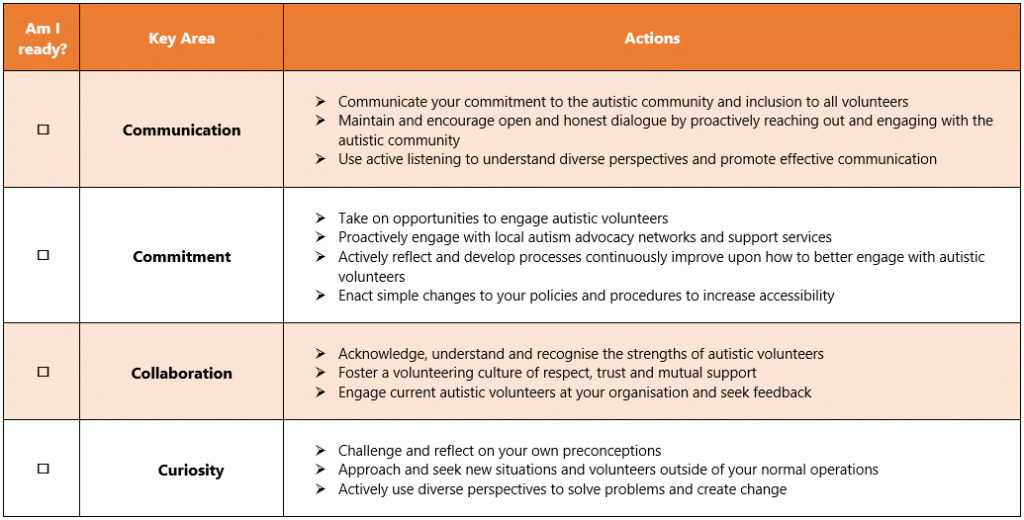
Creating inclusive volunteer programs requires a deliberate and ongoing commitment to accessibility. The first step is to conduct an audit of existing opportunities, identifying barriers that may deter neurodivergent participation. This could involve reviewing application processes, training materials, and the physical environment of volunteer sites. For instance, online applications with open-ended questions may inadvertently exclude those who struggle with abstract or vague prompts. Simplifying language, providing multiple formats for information, and offering clear deadlines can make a significant difference.
Training and onboarding are equally critical. Many organizations assume that all volunteers will benefit from the same orientation, but this overlooks the diverse needs of neurodivergent individuals. Tailored training sessions, which allow for questions to be asked in writing or through a designated contact person, can reduce anxiety and ensure that volunteers fully understand their roles. Additionally, pairing new volunteers with a mentor who understands neurodiversity can provide a supportive framework for learning and growth.
Flexibility is another cornerstone of inclusive volunteering. Rigid schedules and one-size-fits-all expectations often fail to accommodate the varying needs of autistic individuals. Offering part-time or remote opportunities, allowing volunteers to choose their hours, or providing breaks during shifts can make volunteering more accessible. Some organizations have even experimented with “micro-volunteering,” where tasks are broken down into smaller, manageable chunks that can be completed at the volunteer’s own pace. These adaptations not only benefit neurodivergent individuals but also create a more adaptable and resilient volunteer base overall.
The Deeper Fascination: Why Society Fixates on Autism and Volunteerism
The intersection of autism and volunteering is not merely a practical concern—it is a cultural phenomenon that reveals much about society’s evolving relationship with neurodiversity. There is a fascination with the idea of autistic individuals “overcoming” their challenges to contribute to society, a narrative that often frames their participation as exceptional rather than ordinary. This fascination is rooted in a paradox: while society celebrates inclusion, it simultaneously holds neurodivergent individuals to higher standards of proof of their worthiness.
This paradox is evident in the way media portrays autistic volunteers. Stories often emphasize the “inspirational” aspect of their participation, highlighting their contributions as if they were extraordinary acts of heroism rather than natural expressions of community engagement. Such narratives, while well-intentioned, can inadvertently reinforce the idea that neurodivergent individuals must constantly prove their value. The deeper fascination, then, lies not in the act of volunteering itself, but in the societal need to reconcile the tension between inclusion and the discomfort of redefining what it means to be a “productive” member of society.
Moreover, the focus on autism and volunteering reflects a broader cultural obsession with “fixing” neurodivergence through integration. There is an unspoken assumption that autistic individuals must adapt to existing systems rather than the systems adapting to them. This assumption is evident in the way volunteer organizations often prioritize “normalizing” autistic volunteers—encouraging them to mask their traits or conform to neurotypical expectations—rather than reimagining the structures of volunteerism itself. The deeper fascination, then, is with the limits of societal adaptability and the reluctance to confront the systemic changes required to truly embrace neurodiversity.
The path forward lies not in perpetuating these fascinations, but in challenging them. True inclusion requires a shift from viewing neurodivergent individuals as objects of inspiration to recognizing them as equal partners in shaping the future of volunteerism. It demands that society confront its own biases and commit to creating environments where all individuals, regardless of neurotype, can contribute meaningfully without the burden of proving their worth.
Volunteering is more than a transactional act of service—it is a testament to the power of collective effort and the value of diverse perspectives. For autistic individuals, it offers a pathway to self-determination, connection, and societal impact. Yet, the journey to inclusive volunteering is not a passive one; it requires intentional action, empathy, and a willingness to challenge the status quo. By reimagining volunteerism through the lens of neurodiversity, we not only enrich the lives of autistic individuals but also redefine what it means to build a more inclusive society. The true measure of progress is not in the number of autistic volunteers we integrate, but in the depth of the transformations we undergo as a result.