

The notion that autism manifests differently in boys than in girls is one of the most pervasive stereotypes in developmental psychology. For decades, clinicians and educators have operated under the assumption that autism in boys presents with overt behavioral traits—such as repetitive hand-flapping, intense fixations on niche interests, or social withdrawal—while girls, it was believed, either masked their symptoms or exhibited subtler signs that evaded detection. This binary framing has not only skewed diagnostic criteria but has also obscured the nuanced ways in which autism intersects with masculinity, societal expectations, and neurobiological diversity. To dismantle these myths, we must examine the cultural narratives that shape our understanding of autism in boys, the often-overlooked heterogeneity of the condition, and the systemic barriers that prevent accurate identification and support.
At the heart of this misconception lies a deeply ingrained cultural script: boys are expected to be active, vocal, and socially dominant, while girls are encouraged to be empathetic, compliant, and attuned to emotional cues. When a young boy struggles to make eye contact or resists peer pressure, his behavior may be dismissed as mere shyness or defiance rather than a potential indicator of autism. Conversely, a girl who exhibits similar traits might be labeled as “quiet” or “sensitive,” her struggles internalized rather than recognized as part of a broader neurodivergent pattern. This gendered lens distorts our perception of autism, leading to delayed diagnoses in boys who don’t fit the stereotypical mold and missed diagnoses in girls who internalize their challenges. The result is a diagnostic landscape where autism in boys is overrepresented in clinical literature, not because it is more prevalent, but because it aligns with the narrow parameters we’ve constructed for what autism “looks like.”
The Myth of the “Prototypical” Autistic Boy
Popular culture has cemented an image of the autistic boy as a solitary genius, lost in a world of trains, dinosaurs, or mathematical equations, utterly disconnected from his peers. While this trope—exemplified by characters like Sheldon Cooper or Christopher Boone—captures a sliver of the autism spectrum, it fails to account for the vast majority of boys whose experiences diverge from this narrative. Many autistic boys are not socially aloof but rather struggle with the unspoken rules of interaction, misreading sarcasm or missing subtle social cues. Their challenges may manifest as difficulty maintaining friendships, not because they lack interest in connection, but because they approach relationships with a literalness or intensity that peers find overwhelming.
Moreover, the stereotype of the “autistic savant” with extraordinary talents in specific domains is statistically rare. Most autistic boys possess a mix of strengths and struggles, with cognitive abilities that span the full spectrum. Some excel in structured environments where routines and clear expectations provide stability, while others thrive in creative or hands-on pursuits that allow for self-directed exploration. The danger of the “prototypical” autistic boy myth is that it sets an unattainable standard, leading to misdiagnoses or dismissals when a boy’s presentation doesn’t conform. A boy who is highly verbal but struggles with emotional regulation, for instance, may be mislabeled as having ADHD or oppositional defiant disorder, while his underlying autistic traits go unaddressed.
Masking, Compensation, and the Invisible Struggle
One of the most insidious aspects of autism in boys is the phenomenon of masking, where individuals suppress their natural behaviors to conform to social expectations. Boys, in particular, are socialized to prioritize conformity over authenticity, often at great personal cost. A boy might force himself to make eye contact, mimic peers’ social scripts, or suppress stimming behaviors—repetitive movements like rocking or fidgeting—that help regulate his sensory system. Over time, this masking can lead to exhaustion, anxiety, and a profound sense of alienation. The pressure to perform masculinity—stoic, unemotional, and self-reliant—compounds these challenges, as boys may hide their struggles to avoid stigma or vulnerability.
Masking is not a conscious choice but a survival strategy, honed through years of trial and error. A boy who struggles with sensory overload might endure crowded hallways or noisy cafeterias in silence, his distress invisible to adults who assume he is merely “dealing with it.” Similarly, a boy who finds social interactions perplexing might adopt a rigid script for conversations, parroting phrases he’s heard from peers without understanding their nuances. The result is a paradox: the more a boy masks, the more “normal” he appears, and the less likely he is to receive the accommodations he needs. This is particularly true for boys who are verbal and articulate, whose struggles may be dismissed as mere quirks or eccentricities rather than signs of a neurodevelopmental difference.
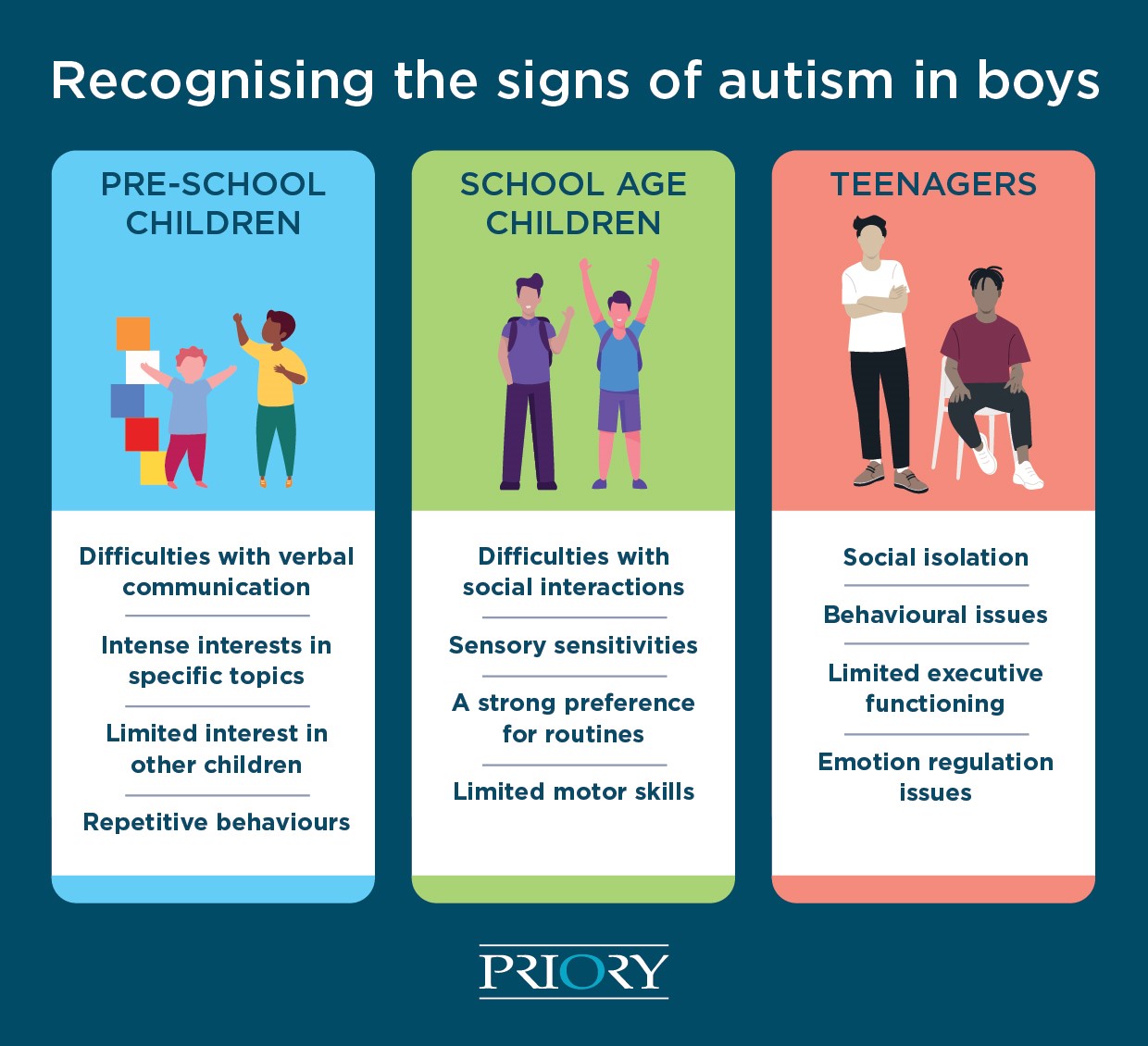
The Role of Sensory Sensitivities in Daily Life
Sensory processing differences are a hallmark of autism, yet they are frequently minimized or misattributed to behavioral issues. For autistic boys, sensory sensitivities can turn mundane environments into sources of profound distress. The hum of fluorescent lights, the texture of certain fabrics, or the scent of cafeteria food may trigger overwhelming reactions, leading to meltdowns or shutdowns that are mistaken for tantrums or laziness. Unlike girls, who may internalize these sensitivities or find ways to camouflage their discomfort, boys are more likely to externalize their distress, drawing attention in ways that are perceived as disruptive.
Consider the experience of a boy in a classroom: the flicker of a projector, the squeak of a chair, or the rhythmic tapping of a pencil can feel like a physical assault, yet he may lack the vocabulary to articulate his discomfort. Instead, he might act out—covering his ears, leaving the room abruptly, or becoming fixated on a seemingly minor detail—behaviors that are often met with frustration rather than empathy. The assumption that these reactions are “behavioral” rather than sensory in origin reflects a fundamental misunderstanding of how autism manifests. It also underscores the need for environments that accommodate neurodiversity, from quiet spaces for sensory breaks to flexible seating arrangements that allow for movement.
Beyond the Stereotypes: The Diversity of Autistic Experiences
To move beyond the stereotypes, we must embrace the diversity of autistic experiences in boys. Not all autistic boys are nonverbal or socially withdrawn; many are highly expressive, creative, and deeply empathetic, albeit in ways that diverge from neurotypical norms. Some boys may struggle with executive function, finding it difficult to plan, organize, or transition between tasks, while others excel in areas requiring pattern recognition or systematic thinking. The key is to recognize that autism is not a monolith but a spectrum of strengths, challenges, and individual differences.
For parents, educators, and clinicians, this means shifting from a deficit-based model—where autism is seen as a list of impairments—to a strengths-based approach that highlights a boy’s unique abilities. A boy who memorizes train schedules might not see his interest as a “special interest” but as a passion that fuels his curiosity. Similarly, a boy who struggles with traditional academics might thrive in hands-on learning environments where he can engage with material in a tactile or visual way. The goal is not to “fix” autism but to provide the tools and supports that allow each boy to navigate the world in a way that honors his neurobiology.
The Systemic Barriers to Diagnosis and Support
Despite growing awareness of autism, systemic barriers continue to impede accurate diagnosis and timely intervention for boys. In many school systems, the criteria for accessing special education services or accommodations are still tied to outdated stereotypes, favoring boys who exhibit overt behavioral challenges over those who mask their struggles. A boy who is quiet and compliant may slip through the cracks, while a boy who is disruptive or noncompliant is more likely to be referred for evaluation. This discrepancy highlights the need for universal screening tools that account for the full range of autistic traits, regardless of gender.
Cultural attitudes also play a role in delaying diagnoses. In some communities, autism is still stigmatized, leading families to avoid seeking evaluations due to fear of judgment or denial. For boys of color, the barriers are even more pronounced, as racial biases in diagnostic criteria and clinician expectations can result in underdiagnosis or misdiagnosis. A Black boy who exhibits hyperactivity might be labeled as having a conduct disorder, while his autistic traits are overlooked. Similarly, a Latino boy who struggles with language delays may be assumed to have a bilingualism-related issue rather than autism. These disparities underscore the importance of culturally responsive assessment practices and the need for greater diversity in the fields of psychology and education.
Redefining Masculinity and Neurodiversity
The intersection of autism and masculinity invites a broader conversation about what it means to be a boy—or a man—in a world that often equates neurodivergence with weakness. Traditional masculinity prizes stoicism, self-sufficiency, and emotional control, traits that can be at odds with the lived experience of autistic boys. A boy who expresses his emotions openly or seeks help when overwhelmed may be teased for being “too sensitive” or “not tough enough.” These messages reinforce the idea that vulnerability is a flaw, rather than a natural part of the human experience.
Challenging these norms requires a cultural shift in how we define strength and resilience. For autistic boys, resilience might look like advocating for their needs, finding communities where they feel accepted, or developing coping strategies that work for them. It might also mean redefining success on their own terms—whether that’s excelling in a niche interest, forming deep one-on-one friendships, or finding fulfillment in creative pursuits. The goal is not to force autistic boys to conform to neurotypical standards but to create a world where their differences are valued rather than pathologized.
Autism in boys is not a monochrome narrative of struggle or genius but a rich tapestry of experiences shaped by biology, culture, and individuality. By dismantling the stereotypes that have long defined our understanding of autism, we can create space for boys to be seen, supported, and celebrated for who they are—not who society expects them to be. The journey begins with listening, with recognizing that behind every behavior is a boy trying to make sense of a world that often feels overwhelming, confusing, or simply too loud. In doing so, we honor not just the diversity of autism, but the diversity of humanity itself.












