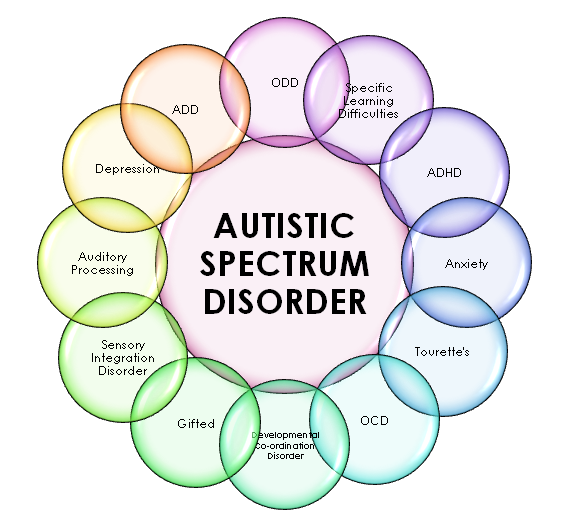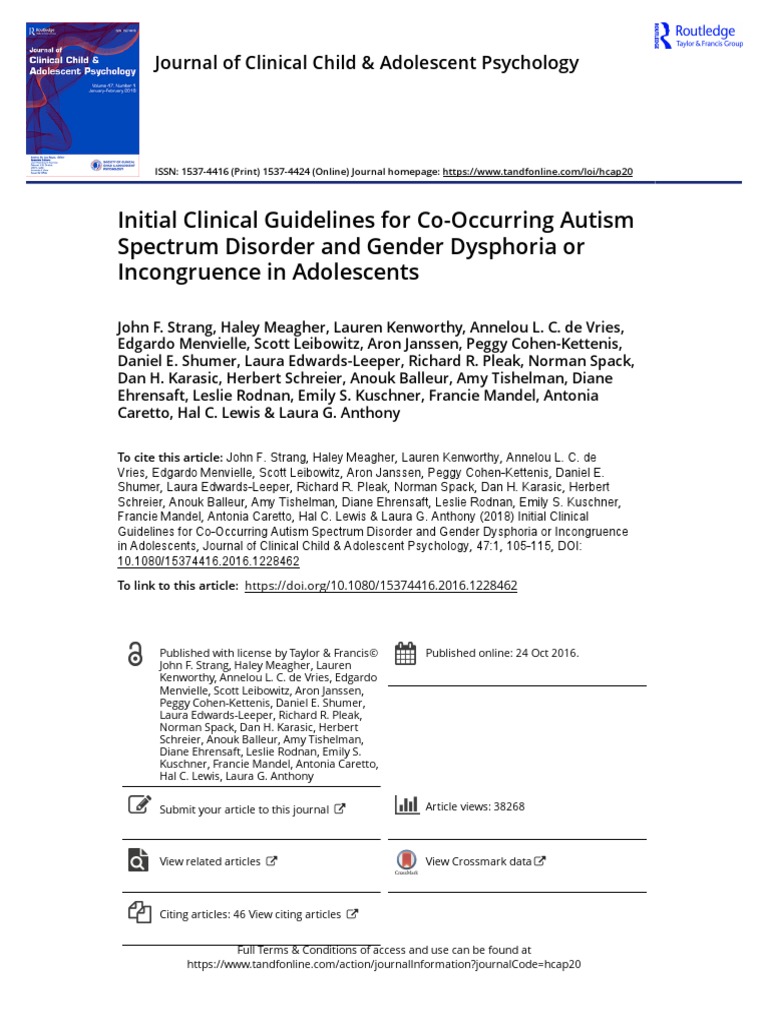
The dance between autism and gender dysphoria is a symphony of contradictions—where the rigid structure of one meets the fluidity of the other, creating a melody that is as perplexing as it is profound. To the uninitiated, these two experiences may seem like distant cousins, tangentially related at best. Yet, for those who navigate their intersection, the synergy is undeniable, a labyrinthine journey where identity is both a fortress and a river, ever-shifting yet immovable in its essence. This exploration is not merely an academic exercise; it is a lived reality for many, a testament to the human capacity for complexity and resilience.
Consider the autistic mind as a finely tuned instrument, its strings vibrating with the precision of a metronome, yet capable of producing dissonant harmonies when the world demands conformity. Gender dysphoria, in this context, is the discordant note that refuses to be silenced—a persistent hum that disrupts the expected cadence of existence. Together, they form a duet that challenges societal norms, forcing us to confront the fragility of labels and the fluidity of selfhood. This article delves into the co-occurring experiences of autism and gender dysphoria, unraveling the threads that bind them and illuminating the unique perspectives they offer.
The Neurodivergent Compass: Navigating Identity Without a Map
Autism is often described as a “different operating system,” a metaphor that underscores the cognitive divergence from neurotypical frameworks. For those with autism, the world is a cacophony of stimuli, each sensation demanding attention, each social cue a cryptic puzzle. Gender, in this context, is no different—another labyrinth where the exit is perpetually obscured by the fog of societal expectations. The autistic individual may experience gender dysphoria not as a fleeting discomfort but as an immutable truth, a fact as concrete as the sensory overload that defines their daily existence.
This rigidity in perception is both a curse and a gift. While it may render the individual vulnerable to the whims of a world that prizes fluidity, it also grants them an unparalleled clarity. Autistic people often describe their gender dysphoria with a stark honesty, devoid of the performative nuances that neurotypical individuals might employ to navigate social waters. Their dysphoria is not a whisper; it is a roar, a demand for recognition that refuses to be drowned out by the noise of convention.
The Dysphoric Mirror: Reflections That Distort and Clarify
Gender dysphoria, when viewed through the lens of autism, becomes a distorting mirror—one that reflects not the self as society sees it, but the self as it truly is. For many autistic individuals, the disconnect between their internal sense of gender and their external presentation is not a matter of choice but of survival. The body, in this context, is a prison, its contours a constant reminder of the chasm between who they are and who they are expected to be.
This dissonance is not merely emotional; it is visceral. The texture of clothing, the weight of a binder, the sensation of a name that does not resonate—each of these can be a source of profound distress. Yet, within this distress lies a paradox: the very rigidity that defines autism can also serve as a catalyst for transformation. The autistic individual’s refusal to compromise on their truth can be a radical act, a declaration that identity is not a negotiation but an absolute.

The Social Scaffold: When the World Fails to Recognize the Self
Society’s response to autism and gender dysphoria is often one of bemusement or dismissal. Autistic individuals are frequently labeled as “eccentric” or “quirky,” their struggles reduced to mere oddities. Similarly, gender dysphoria is often met with skepticism, particularly when it manifests in ways that defy traditional narratives. When these two experiences converge, the result is a double-edged sword: the individual is doubly misunderstood, their pain dismissed as either a “phase” or a “symptom.”
This lack of recognition can be devastating. The autistic individual with gender dysphoria may find themselves trapped in a cycle of self-doubt, their truth invalidated by a world that refuses to see them. Yet, it is precisely this erasure that fuels their resilience. The refusal to be silenced becomes a form of rebellion, a quiet assertion that their existence is valid, regardless of societal approval.
The Alchemy of Self-Discovery: Transformation in the Crucible of Struggle
The intersection of autism and gender dysphoria is not merely a site of struggle; it is also a crucible for transformation. For many, the journey toward self-acceptance is a nonlinear path, marked by false starts and unexpected revelations. The autistic mind, with its propensity for hyperfocus and pattern recognition, may find solace in the exploration of gender identity, treating it as another puzzle to solve. This analytical approach can lead to a deeper understanding of self, unencumbered by the emotional baggage that often accompanies gender dysphoria in neurotypical individuals.
The process of transitioning, whether social, medical, or legal, can be both liberating and daunting. For autistic individuals, the binary of “before” and “after” transition may feel less like a dramatic shift and more like a gradual unfolding. The body, once a source of dysphoria, may become a canvas for self-expression, its contours reshaped to reflect an inner truth. Yet, this transformation is not without its challenges. The sensory and social complexities of transitioning can be overwhelming, requiring a level of adaptability that is often in short supply in a neurotypical world.
The Unseen Threads: How Autism Shapes the Experience of Dysphoria
Autism does not merely coexist with gender dysphoria; it reshapes it. The autistic individual’s experience of dysphoria is often more intense, more all-consuming, than that of their neurotypical counterparts. This is not to say that neurotypical individuals do not suffer—only that their suffering is mediated by social scripts and coping mechanisms that autistic individuals may lack. For the autistic person, dysphoria is not a passing cloud but a storm that rages without respite.
Yet, this intensity is not without its rewards. The autistic individual’s capacity for deep introspection and unwavering self-honesty can lead to a form of gender dysphoria that is uniquely their own. It is a dysphoria that is not diluted by societal expectations, not softened by the need for approval. It is, in its purest form, a raw and unfiltered confrontation with the self.

The Future of Understanding: Toward a More Inclusive Dialogue
The conversation surrounding autism and gender dysphoria is still in its infancy. While awareness has grown, the nuances of their intersection remain largely unexplored. This is not merely an academic oversight; it is a societal one. The failure to recognize the unique experiences of autistic individuals with gender dysphoria perpetuates a cycle of erasure, leaving many to navigate their truth in silence.
Yet, there is hope. The rise of neurodiversity-affirming approaches to gender identity is a step in the right direction, offering a framework that acknowledges the complexity of these experiences. As society becomes more attuned to the diversity of human experience, the stories of autistic individuals with gender dysphoria will find their place in the broader narrative of identity. This is not a call for pity or sympathy but a plea for recognition—for the understanding that their experiences are not anomalies but valid expressions of the human condition.
The dance between autism and gender dysphoria is a delicate one, a balance of fragility and strength, of silence and roar. It is a testament to the resilience of the human spirit, a reminder that identity is not a fixed point but a journey. And for those who walk this path, the destination is not an end but a beginning—a chance to live authentically, unapologetically, and without the weight of societal expectations.
In the end, the intersection of autism and gender dysphoria is not a problem to be solved but a reality to be embraced. It is a reminder that the most profound truths are often the ones that defy easy categorization, the ones that demand we look beyond the surface to see the depth beneath. And it is in that depth that we find the beauty of human complexity—the unyielding, ever-evolving tapestry of identity.