Autism and obsessive-compulsive disorder (OCD) often intersect in ways that can perplex even the most astute observers. At first glance, their shared traits—rigid routines, intense focus on specific details, and an almost ritualistic adherence to order—suggest a deep, intrinsic connection. Yet beneath this surface similarity lies a labyrinth of neurological and psychological distinctions that define each condition uniquely. The fascination with their overlap isn’t merely academic; it’s a window into the human mind’s capacity for both repetition and variation, where the boundaries between difference and disorder blur in intriguing ways.
The interplay between autism and OCD is not just a clinical curiosity—it’s a lived experience for many. Imagine a mind that perceives the world in hyper-specific fragments, where the need for predictability isn’t just a preference but a survival mechanism. Now, layer onto that a relentless inner voice demanding adherence to invisible rules, and the result is a cognitive landscape where order and chaos wage a silent war. This duality is what makes their relationship so compelling: it’s not just about symptoms but about the fundamental ways in which people navigate reality when their brains process it differently.
The Cognitive Rhythms of Repetition: Where Autism and OCD Converge
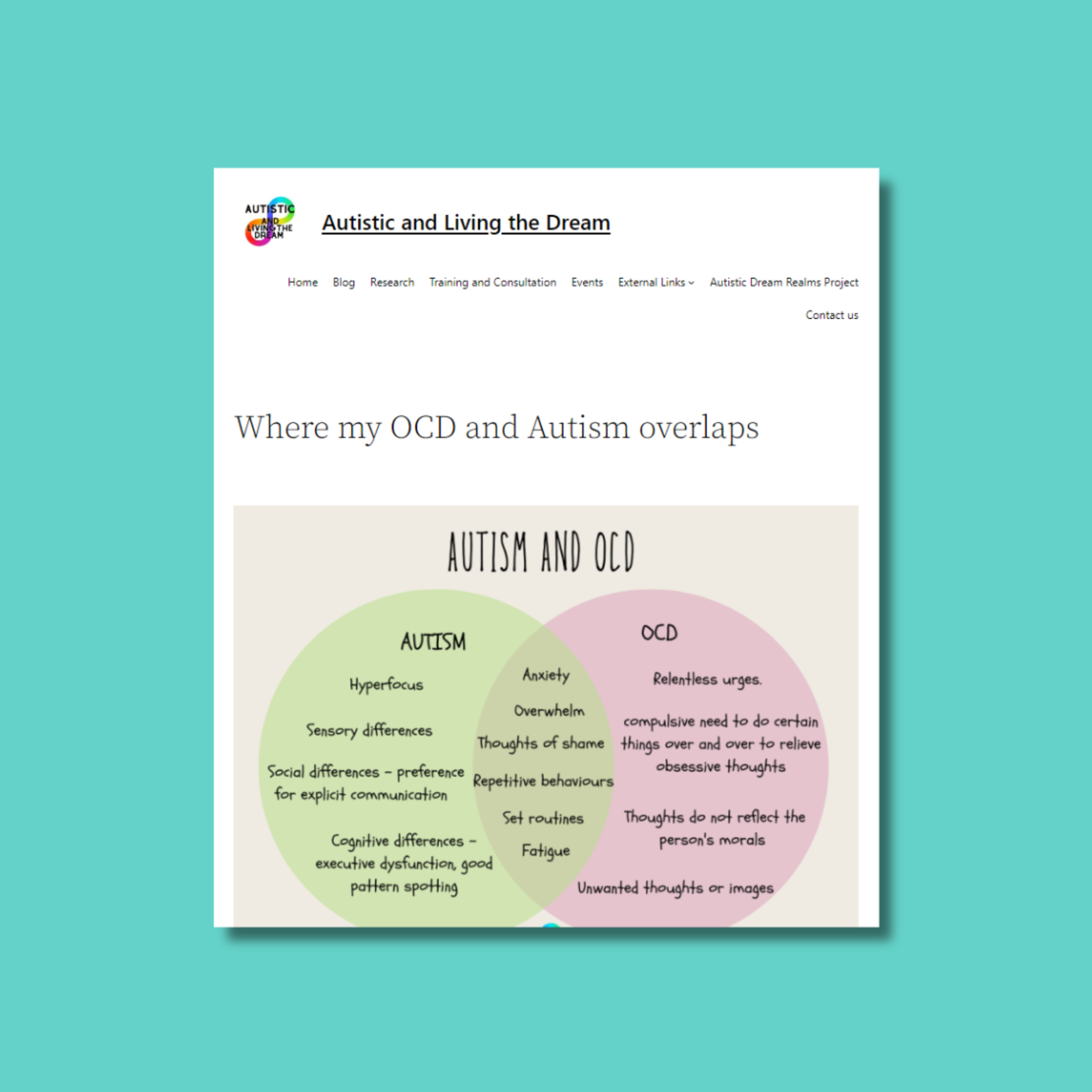
At the heart of both autism and OCD lies a preoccupation with repetition—not as a fleeting habit, but as a cornerstone of how the mind constructs meaning. In autism, repetitive behaviors often serve as a coping mechanism, a way to impose structure on an overwhelming sensory world. These might manifest as stimming (self-stimulatory behaviors like hand-flapping or rocking), insistence on sameness, or an intense focus on narrow interests. The brain, in its quest for predictability, clings to these patterns as anchors in a sea of unpredictability.
OCD, on the other hand, frames repetition as a defense against perceived threats. The compulsions—whether hand-washing, checking, or mental rituals—are not just habits but desperate attempts to neutralize anxiety. What ties these two conditions together is the idea of intrusive thoughts and the need for control. In autism, the intrusive thoughts might be an overwhelming sensory input or an unshakable routine being disrupted. In OCD, they’re often distressing, ego-dystonic thoughts that demand ritualistic resolution. Both conditions, in their own ways, reflect a mind that is constantly negotiating with the chaos of existence.
The overlap becomes even more pronounced when considering the hyperfocus seen in both. Autistic individuals may hyperfocus on a topic of interest, losing track of time and external stimuli. Similarly, someone with OCD might hyperfocus on a feared outcome, becoming consumed by the need to prevent it. This shared intensity—whether directed outward toward the world or inward toward the self—suggests a deeper neurological rhythm at play, one where the brain’s reward systems are hijacked by the pursuit of order.
The Neural Tapestry: Unraveling the Brain’s Distinct yet Intertwined Pathways
Neuroscience offers clues to why autism and OCD might share such striking similarities. Both conditions involve dysregulation in the basal ganglia, a brain region critical for habit formation and impulse control. In OCD, this dysregulation often leads to an overactive orbitofrontal cortex, which amplifies the sense of threat and the urgency to perform compulsions. In autism, the basal ganglia may be involved in the rigid adherence to routines, though the mechanisms are less about fear and more about the brain’s need for consistency.
Dopamine, the neurotransmitter associated with reward and motivation, also plays a dual role in both conditions. In autism, dopamine imbalances may contribute to the intense focus on specific interests, creating a feedback loop where repetition becomes reinforcing. In OCD, dopamine dysregulation is linked to the compulsive behaviors that temporarily alleviate anxiety, even if they perpetuate the cycle. This shared neurochemical terrain hints at why the two conditions can coexist so seamlessly in some individuals—because their brains are wired to seek out patterns, whether those patterns are comforting or compulsive.

Yet, the differences are just as telling. Autism often involves a global processing style, where the brain integrates information in a holistic, sometimes fragmented way. OCD, contrastingly, is marked by local processing, where attention fixates on minute details at the expense of the bigger picture. This divergence explains why autistic individuals might struggle with social nuances but excel in systems thinking, while those with OCD may become paralyzed by the fear of making a mistake in a seemingly trivial task.
From Rituals to Routines: The Social and Emotional Dimensions
The social implications of autism and OCD reveal another layer of their complexity. Autism is fundamentally a social communication disorder, where the challenge lies in interpreting and responding to the unwritten rules of human interaction. The repetitive behaviors in autism are often a response to social overwhelm, a way to self-regulate in a world that feels unpredictable and exhausting. OCD, meanwhile, is less about social interaction and more about the internal struggle to manage anxiety. The compulsions may isolate the individual, but the root of the issue is the fear of what might happen if the rituals aren’t performed.
This distinction is crucial when considering how each condition affects relationships. An autistic person might struggle to understand sarcasm or facial expressions, leading to misunderstandings with peers. Someone with OCD might cancel plans last-minute due to contamination fears, straining their connections with others. The overlap here is in the invisibility of the conditions—both can be misinterpreted as stubbornness, laziness, or defiance when, in reality, they’re manifestations of an internal battle.
Emotionally, the two conditions diverge in their relationship to distress. Autism often involves alexithymia, a difficulty in identifying and describing emotions, which can make the experience of anxiety feel amorphous and unmanageable. OCD, conversely, is characterized by hyperawareness of emotions, particularly fear, which becomes the driving force behind compulsions. This contrast underscores a broader theme: autism is often about not knowing how to feel, while OCD is about feeling too much.
The Spectrum Within the Spectrum: Why Comorbidity Isn’t a One-Size-Fits-All
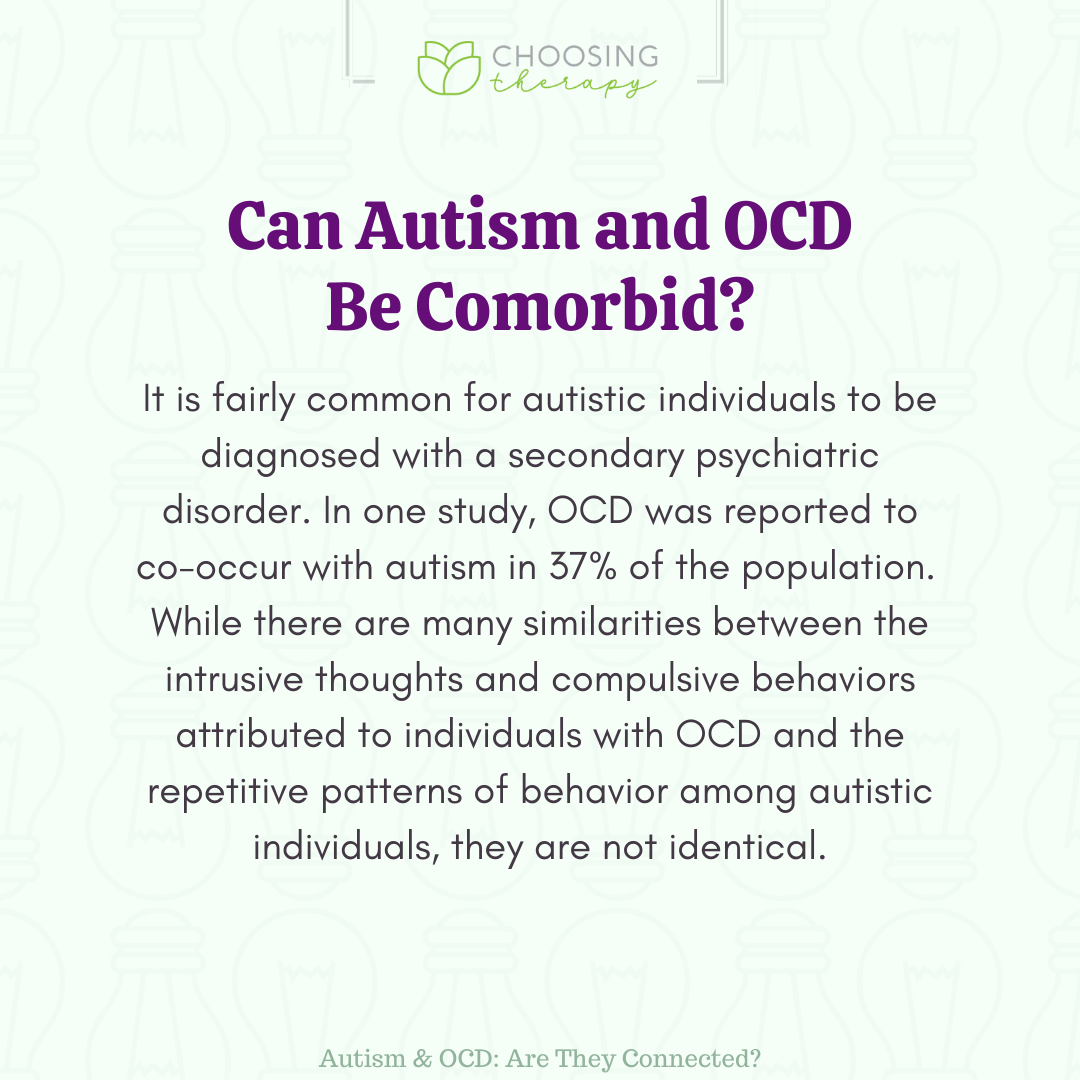
Not everyone with autism will have OCD, and not everyone with OCD will exhibit autistic traits. The comorbidity rate, however, is higher than chance, suggesting that there’s something about the way these minds are wired that makes them more susceptible to both conditions. For some, the overlap is minimal—a few rigid routines or mild compulsions. For others, it’s a profound intertwining where autism amplifies OCD’s intensity or vice versa.
Consider the case of an autistic individual who develops OCD as a secondary response to their primary condition. The stress of navigating a neurotypical world might trigger obsessive thoughts about safety or contamination, leading to compulsive behaviors that weren’t present in childhood. Conversely, someone with OCD might develop autistic-like traits as a result of years of social isolation, their coping mechanisms evolving into a more rigid, autistic-style framework for understanding the world.
This fluidity within comorbidity highlights the importance of individualized understanding. Labels like “autistic with OCD traits” or “OCD with autistic features” aren’t just clinical shorthand—they’re acknowledgments of a lived experience that doesn’t fit neatly into diagnostic boxes. The spectrum within the spectrum is where the most nuanced stories lie, where the interplay of traits creates a unique cognitive fingerprint.
Breaking the Cycle: Therapeutic Approaches and the Path Forward
Treating the overlap of autism and OCD requires a delicate balance between addressing the compulsive behaviors and respecting the need for routine. Traditional OCD therapies like exposure and response prevention (ERP) can be challenging for autistic individuals, as the rigid adherence to routines might make the “exposure” part feel like an existential threat. Adapted therapies, such as gradual exposure with predictability, can help bridge this gap, allowing the individual to confront their fears without feeling overwhelmed by change.
Medication, too, plays a role, though its effectiveness varies. SSRIs, commonly prescribed for OCD, may also help with co-occurring anxiety in autism, though they can sometimes exacerbate sensory sensitivities. The key is a collaborative approach, where therapists, psychiatrists, and the individual (and their support network) work together to tailor interventions that respect both the compulsive and autistic aspects of their experience.
Beyond clinical interventions, societal shifts are equally vital. Recognizing that repetitive behaviors aren’t always “bad” or “wrong” is a start—whether it’s stimming in autism or hand-washing in OCD, these actions often serve a purpose. The goal isn’t to eliminate repetition but to understand its roots and find healthier ways to meet those needs. For some, that might mean creating structured environments; for others, it might involve learning to tolerate uncertainty without resorting to compulsions.
The dance between autism and OCD is a testament to the brain’s remarkable capacity for adaptation—and its vulnerability to getting stuck in loops. Their overlap isn’t a flaw but a feature of how human cognition can diverge from the expected, creating patterns that are both beautiful and bewildering. To study their intersection is to peer into the mechanics of the mind itself, where the pursuit of order and the fear of chaos are two sides of the same coin. In understanding this relationship, we don’t just gain insights into two conditions; we uncover a deeper truth about what it means to navigate a world that often feels too loud, too unpredictable, and too demanding of our attention.