In the labyrinth of human development, sexuality unfolds like a river carving through stone—sometimes a gentle stream, other times a torrential force, but always shaping the landscape of identity. For individuals on the autism spectrum, this river flows through terrain less charted, where societal currents clash with neurological uniqueness. Autism and sexuality are not adversaries, but rather two facets of a complex gem, refracting light in ways that challenge conventional perceptions. To understand this interplay is to witness a dance between instinct and interpretation, where every step reveals a story untold.
The journey begins not with labels, but with the recognition that sexuality is not a monolith—it is a spectrum as varied as the individuals who navigate it. Autism, too, exists on a spectrum, and when these two converge, the result is a tapestry woven from threads of difference, resilience, and unfiltered authenticity. This exploration is not about pathologizing or romanticizing, but about illuminating the nuances that make each experience singular. It is about peeling back the layers of stigma to reveal the raw, unfiltered humanity beneath.

The Uncharted Waters of Autistic Sexuality
Imagine sexuality as a vast ocean, its depths teeming with currents that guide, confuse, and sometimes overwhelm. For autistic individuals, these waters may feel colder or warmer, their tides more unpredictable. The challenge lies not in the absence of desire, but in the dissonance between internal compass and external expectations. Social scripts—those unspoken rules governing behavior—are often indecipherable, leaving autistic individuals to navigate intimacy like sailors charting unknown seas without a map.
This dissonance is not a flaw, but a feature of a mind that processes the world differently. Where neurotypical individuals might intuitively grasp the subtleties of flirtation or consent, autistic individuals may rely on explicit communication, literal interpretations, or structured frameworks. The result? A sexuality that is neither less valid nor less profound, but one that demands patience, education, and a willingness to listen without judgment. It is a sexuality that thrives in clarity, where ambiguity is the enemy and honesty is the compass.
Consider the autistic teenager who, upon discovering their attraction to a classmate, might not grasp the nuances of “playing hard to get” or “reading between the lines.” Their approach is direct, unburdened by the artifice that often clouds neurotypical interactions. This directness can be misconstrued as inappropriate, when in reality, it is a refreshing departure from the performative dance of modern romance. It is sexuality stripped of pretense, a reminder that desire need not be a puzzle to be solved, but a truth to be honored.
The Spectrum of Desire: Beyond Binary Labels
Sexuality is not a straight line, but a constellation of possibilities, and autism further complicates this celestial map. The assumption that autistic individuals are asexual or hypersexual is a myth as outdated as it is reductive. In truth, their desires are as diverse as the spectrum itself—some may experience a heightened sensitivity to sensory stimuli, leading to an aversion to certain textures or pressures, while others might crave connection with an intensity that borders on obsession. The key lies in recognizing that these experiences are not deviations, but variations on a theme.
For some autistic individuals, sexuality is a quiet whisper, a subtle undercurrent that guides their interactions without demanding center stage. For others, it is a roaring fire, a consuming force that requires careful management and understanding. The challenge for caregivers, educators, and partners is to meet these experiences with the same curiosity and respect afforded to any other form of human expression. It is about asking, not assuming; listening, not prescribing.
Take, for example, the autistic adult who finds solace in online communities, where the absence of physical cues allows them to explore their identity without the pressure of real-time interpretation. Here, sexuality becomes a digital sanctuary, a space where words are the only currency, and misunderstandings are minimized. This is not escapism, but adaptation—a testament to the ingenuity of a mind that finds its own path to fulfillment.

The Consent Conundrum: Clarity in a World of Ambiguity
Consent is the cornerstone of ethical intimacy, yet for autistic individuals, its boundaries can feel as fluid as quicksand. The concept of consent is not inherently complex, but the social cues that signal it often are. Averted eyes, hesitant body language, or even silence can be misinterpreted as agreement, while direct refusal might be overlooked in favor of perseverance. This is not a lack of empathy, but a different wiring—one that prioritizes logic over intuition.
The solution lies in education that is as practical as it is compassionate. Teaching autistic individuals about consent is not about instilling fear, but about equipping them with tools to navigate relationships safely and respectfully. It is about replacing vague social norms with clear, actionable guidelines: “Ask before touching,” “Respect when someone says no,” “Check in during intimacy.” These are not rules to stifle spontaneity, but lifelines to prevent harm.
Consider the autistic adult who, after a workshop on consent, begins to recognize the importance of verbal confirmation. They might still struggle with the nuances of tone or facial expressions, but they now understand that silence is not consent, and persistence is not a virtue. This is progress—not in changing who they are, but in empowering them to express their desires in ways that honor both themselves and their partners.
Sensory Intimacy: The Body as a Compass
For many autistic individuals, sexuality is inextricably linked to sensory experiences. The texture of a fabric, the scent of a perfume, the sound of a voice—these can be as intoxicating as they are overwhelming. Intimacy, then, is not just about emotional connection, but about creating an environment where sensory input is controlled, predictable, and pleasurable. This might mean dim lighting to reduce visual overload, or avoiding certain fabrics that trigger discomfort. It might mean exploring solo before engaging in partnered intimacy, to understand one’s own boundaries without the pressure of performance.
This sensory-aware approach to sexuality is not a limitation, but a superpower. It allows for a level of intentionality and mindfulness that many neurotypical individuals might envy. Imagine an autistic person who, through trial and error, discovers that they are most aroused in a quiet room with soft music and a specific type of touch. This is not a compromise, but a revelation—a way to experience pleasure on their own terms, without the noise of societal expectations.
The challenge, then, is to extend this sensory awareness to partnered relationships. Partners of autistic individuals must be willing to communicate openly about preferences, to adapt their own behaviors, and to prioritize comfort over convention. This is not about reducing intimacy to a checklist, but about elevating it to an art form—one where every detail is considered, and every sensation is savored.
The Role of Education: Bridging the Knowledge Gap
Education is the bridge between isolation and understanding, yet too often, autistic individuals are left to navigate sexuality without a guide. Schools may skirt the topic, caregivers may feel ill-equipped, and society at large may view autistic sexuality as a taboo. The result? A generation of individuals who feel shame, confusion, or even danger in exploring their desires. The antidote is comprehensive, accessible education that addresses not just the mechanics of sex, but the emotional and social dimensions as well.
This education must be tailored to the individual’s cognitive and emotional needs. For some, it might involve visual aids, social stories, or role-playing scenarios. For others, it might mean open conversations about boundaries, desires, and the importance of mutual respect. The goal is not to impose a one-size-fits-all narrative, but to provide the tools for autistic individuals to craft their own stories, informed by knowledge and free from stigma.
Love in All Its Forms: Redefining Relationships
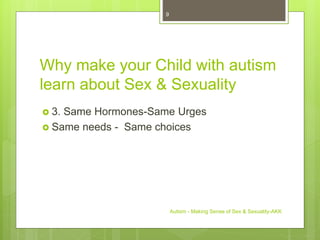
Sexuality is not the sole domain of romantic relationships. For autistic individuals, love might manifest in friendships, familial bonds, or even self-exploration. The pressure to conform to a narrow definition of intimacy can be stifling, but when these boundaries are relaxed, a world of possibility emerges. Autistic individuals may form deep, meaningful connections that defy traditional labels, where emotional intimacy is prioritized over physicality, or where sensory experiences take precedence over societal norms.
This redefinition of relationships is not about rejecting convention, but about expanding it. It is about recognizing that love is not a monochrome painting, but a vibrant mosaic of experiences. An autistic individual might find fulfillment in a platonic relationship that offers the same depth of connection as a romantic one, or they might explore asexuality as a valid and fulfilling identity. The key is to validate these experiences without imposing a hierarchy of desire.
The journey toward understanding autistic sexuality is not a linear one. It is a winding path, fraught with challenges but also illuminated by moments of profound clarity. It is a reminder that diversity is not a deviation, but the very essence of human experience. By embracing the unique ways in which autistic individuals navigate intimacy, we not only enrich our understanding of sexuality but also celebrate the full spectrum of human connection.
In the end, autism and sexuality are not two separate entities, but threads in the same tapestry. They are proof that the human experience is not a straight line, but a constellation of stars, each one shining with its own light. To understand this is to take a step toward a world where every individual, regardless of neurology, is free to explore their desires with dignity, respect, and unapologetic authenticity.