
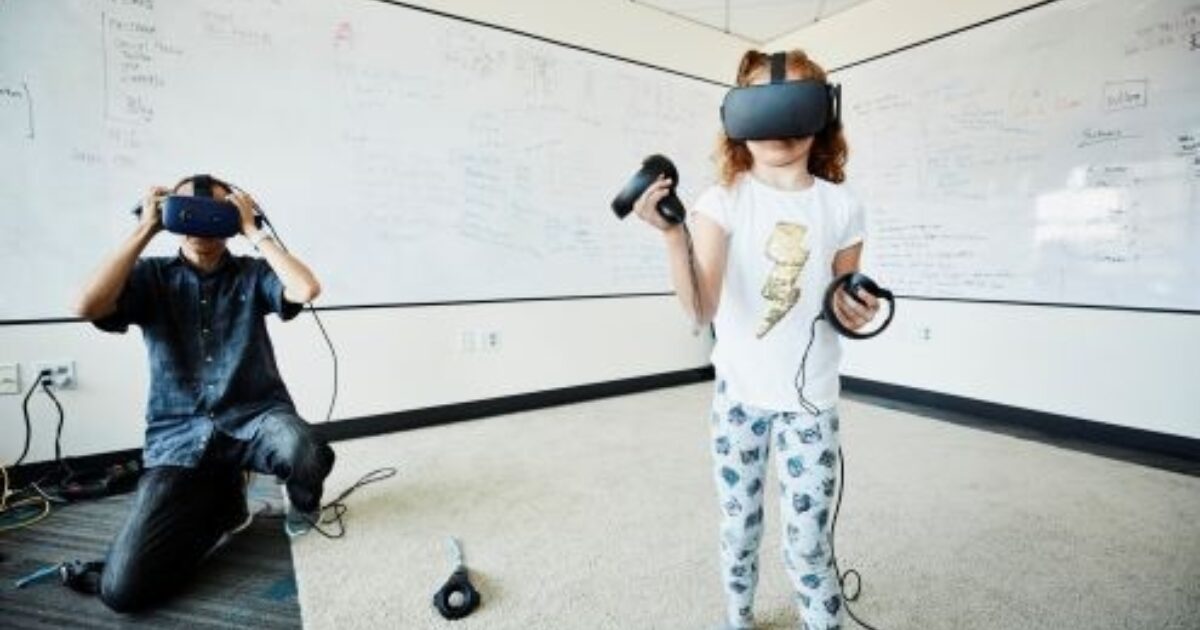
In the labyrinth of human cognition, where words often stumble like tangled threads, autism presents a unique topography—one where traditional bridges of communication may feel too narrow or too steep. Yet, within this intricate terrain, augmented reality (AR) emerges not as a mere tool, but as a luminous cartographer, redrawing pathways of connection with precision and empathy. Unlike virtual reality’s immersive cocoons, AR overlays the tangible world with digital whispers, transforming everyday environments into interactive classrooms where social and communication skills can flourish. It is neither a crutch nor a gimmick; it is a symphony of synchronicity, harmonizing perception with interaction in real time. As we step into this augmented frontier, we uncover how AR doesn’t just mimic reality—it reimagines it, offering autistic individuals a scaffold to navigate the often-daunting social landscape with newfound confidence and clarity.
The Alchemy of Augmented Reality: Transmuting Perception into Connection
At its core, augmented reality is an alchemist’s dream—a fusion of the physical and digital that transmutes abstract social cues into tangible, interactive experiences. For individuals on the autism spectrum, who may grapple with interpreting facial expressions, tone of voice, or unwritten social rules, AR acts as a cognitive prosthesis, translating the invisible into the visible. Imagine a child walking into a classroom where the walls themselves become guides: a glowing halo around a peer’s face signals engagement, while a subtle color shift in the air indicates a shift in emotional tone. These aren’t mere visual effects; they are sensory translations, turning the ephemeral into the concrete.

This alchemy extends beyond visual cues. AR can integrate haptic feedback—gentle vibrations or pressure points—to reinforce turn-taking in conversation or to signal when personal space boundaries are crossed. It’s as if the world itself begins to speak in a language of light and touch, reducing the cognitive load of decoding social norms. For many autistic individuals, the frustration of misreading signals can lead to withdrawal or anxiety; AR doesn’t eliminate these challenges but provides a real-time translator, one that adapts to the user’s pace and comfort. The result? A gradual, organic shift from confusion to comprehension, from isolation to inclusion.
From Static to Dynamic: AR as a Social Playground
Traditional social skills training often relies on static scenarios—role-playing with peers or watching pre-recorded videos—tools that can feel as rigid as a museum diorama. AR, by contrast, turns the world into a living, breathing sandbox, where social interactions unfold dynamically and unpredictably, much like real life. Consider a scenario where an autistic teenager uses AR glasses to navigate a café. As they approach the counter, the system highlights the barista’s facial expressions in real time, offering contextual clues: a furrowed brow might indicate confusion, while a slight smile could signal friendliness. These cues are not imposed but co-created with the environment, making the learning process feel organic rather than didactic.
The magic of AR lies in its ability to gamify social learning without trivializing it. Users might engage in a game where they must identify emotions in a crowd, earning points for accuracy. The stakes are low, the feedback immediate, and the repetition endless—until the skills become second nature. This approach leverages the autistic brain’s affinity for patterns and systems, turning social navigation into a puzzle to be solved rather than a minefield to avoid. Over time, what begins as a structured exercise evolves into intuitive social intuition, as the brain internalizes these augmented experiences as part of its natural repertoire.

The Bridge of Context: AR and the Nuances of Communication
Communication is not a monologue but a polyphony—a chorus of words, tone, body language, and timing. For autistic individuals, the challenge often lies in harmonizing these elements, especially when they conflict or overlap. AR steps in as a conductor of context, providing real-time annotations that clarify intent. Imagine a conversation where sarcasm is misinterpreted; AR could subtly highlight the speaker’s facial micro-expressions or vocal inflections, offering a visual cue that tempers the literal interpretation of the words. It’s as if the air between speakers becomes a canvas of clarifying light, illuminating the unspoken.
This contextual scaffolding is particularly powerful in group settings, where social dynamics can feel like a high-wire act. AR can flag when a speaker is about to finish their turn, or when a pause in conversation might signal an opportunity to interject. For those who struggle with the rhythm of reciprocity, these cues act as a metronome, keeping the interaction in sync. The technology doesn’t replace intuition; it amplifies it, allowing autistic individuals to participate more fully in the ebb and flow of dialogue without the paralyzing fear of misstep.
Moreover, AR can adapt to individual needs. A user with sensory sensitivities might configure the system to minimize overwhelming visuals, while another might prioritize auditory cues for tone analysis. This personalized augmentation ensures that the technology serves as a bridge rather than a barrier, respecting the user’s unique sensory and cognitive profile.
The Ripple Effect: AR’s Impact Beyond the Individual
The benefits of AR extend far beyond the autistic user, creating a ripple effect that transforms social ecosystems. Educators, for instance, can use AR to design inclusive curricula where social skills are taught not in isolation but within the context of real-world interactions. A history lesson might include an AR overlay that simulates a debate, with visual cues guiding students through the nuances of persuasion and active listening. The classroom becomes a living laboratory, where abstract concepts are made tangible through augmented experience.
Families, too, find new avenues for connection. Parents and siblings can use AR to participate in social exercises alongside their autistic loved ones, fostering shared understanding and reducing frustration. A simple game of charades, enhanced by AR annotations, becomes a collaborative adventure rather than a source of tension. The technology doesn’t just aid communication; it redefines it as a shared journey.
In the workplace, AR can level the playing field for autistic adults navigating professional environments. Job interviews, team meetings, and client interactions can be rehearsed in augmented reality, with real-time feedback on body language, eye contact, and vocal tone. The result is a workforce that is not just diverse in neurotype but also equipped with the tools to thrive within it. AR doesn’t erase differences; it celebrates them by providing the scaffolding to bridge them.
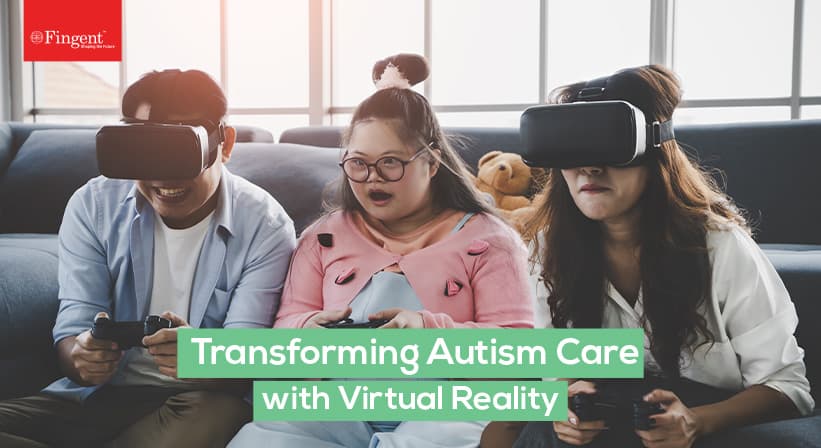
The Horizon of Possibility: AR and the Future of Neurodiversity
As augmented reality continues to evolve, so too does its potential to redefine neurodiversity. Future iterations may incorporate artificial intelligence to predict social scenarios before they unfold, offering proactive guidance rather than reactive support. Imagine an AR system that, upon entering a new space, instantly maps out the social topography—identifying key individuals, their likely emotional states, and optimal interaction points. It’s a crystal ball of social intelligence, one that empowers autistic individuals to navigate the world with foresight rather than trepidation.
Yet, the true promise of AR lies not in its technological sophistication but in its human-centric design. The best augmented experiences are those that fade into the background, becoming as natural as breathing. They don’t draw attention to the tool but to the person using it, ensuring that the focus remains on connection rather than correction. In this way, AR becomes more than a bridge—it becomes a mirror, reflecting the inherent worth and potential of every individual, regardless of how they process the world.
As we stand on the precipice of this augmented future, it’s essential to approach AR not as a panacea but as a partner in growth. It won’t rewrite the rules of social interaction, but it will rewrite the way those rules are learned and applied. For autistic individuals, AR offers something profound: the chance to see the world not as a series of obstacles to overcome, but as a landscape of endless possibility, where every interaction is an opportunity to connect, to learn, and to belong.
The journey of autism and augmented reality is not one of transformation but of revelation. It reveals the hidden layers of social interaction, the unspoken nuances that shape our connections, and the untapped potential that lies within every individual. In this augmented world, no one is left to decipher the code alone. Instead, the code itself becomes a guide—a luminous thread weaving through the fabric of reality, leading toward a future where communication is not a barrier but a bridge, and where every voice, no matter how it speaks, is heard.












