Can the levels of autism truly fluctuate throughout a person’s life, or is the label set in stone from the moment of diagnosis? This question teeters on the intersection of curiosity and complexity, compelling us to consider the fluid nature of neurodevelopmental conditions in a world that often craves definitive categorizations. Autism is widely recognized as a spectrum, a continuum that defies simplistic classifications, but what if the position along that spectrum itself is not static? Exploring this enigma invites a nuanced understanding of autism’s evolving landscape as individuals journey through various life stages.
The Dynamic Nature of Autism Diagnoses
Autism, commonly referred to as Autism Spectrum Disorder (ASD), encompasses a diverse range of characteristics, behaviors, and severities. The concept of “levels” of autism typically refers to the degree of support an individual needs and the intensity of symptoms they exhibit. Yet, these levels are not immutable categories etched indelibly into one’s developmental fate. Instead, they represent a snapshot in time—a reflection of an individual’s current capabilities and challenges.
The clinical application of autism levels often aligns with the Diagnostic and Statistical Manual of Mental Disorders (DSM-5), which outlines three levels based on support needs: Level 1 (requiring support), Level 2 (requiring substantial support), and Level 3 (requiring very substantial support). However, this framework, while useful, is inherently reductive when faced with the complexity of human development. It can obscure the reality that behaviors and abilities may wax and wane due to myriad influences, from intervention efficacy to environmental changes, or even neurological maturation.
Neuroplasticity: The Brain’s Remarkable Ability to Adapt
One indispensable concept in contemplating changes in autism levels is neuroplasticity—the brain’s lifelong capacity to reorganize and adapt. Neuroplasticity demonstrates that neural pathways can be strengthened, weakened, or rerouted based on experiences, learning, and even rehabilitation techniques. This adaptability shines as a beacon of hope and rationale behind the potential for shifts in autism severity and functioning over time.
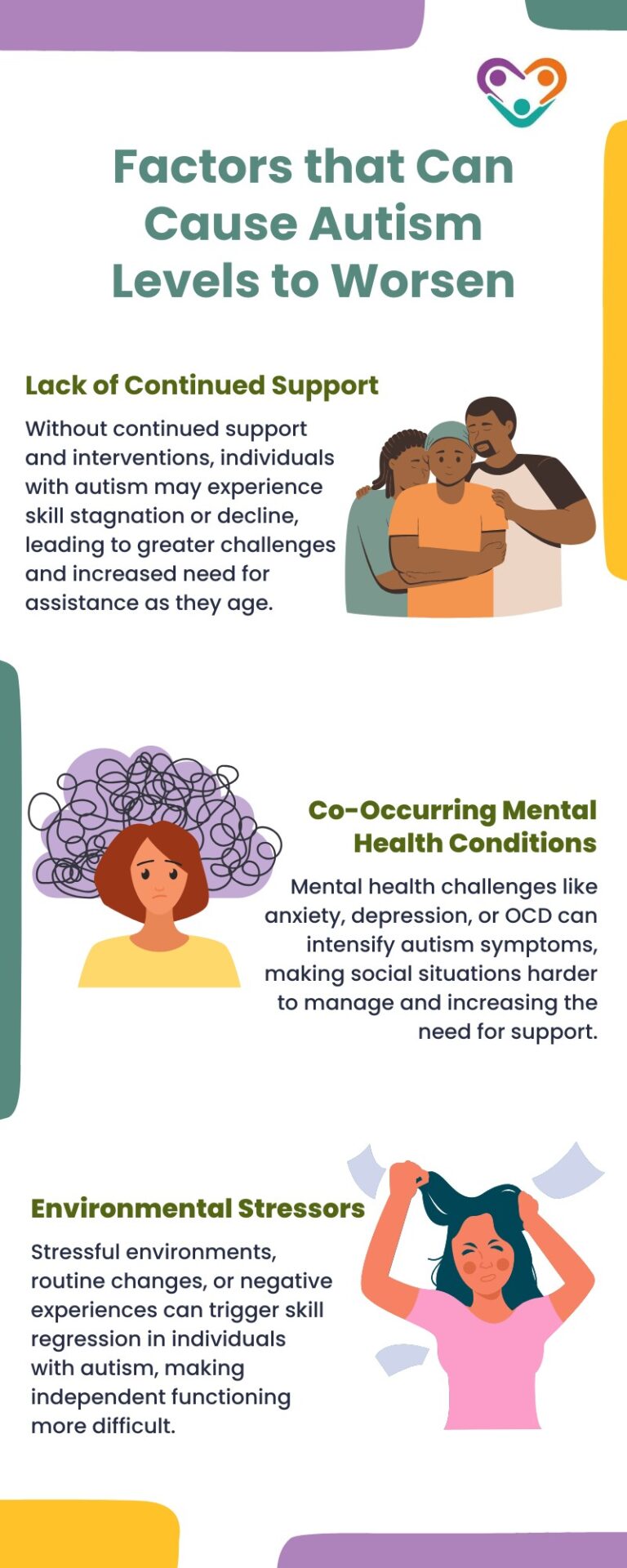
For example, early and intensive behavioral interventions can harness neuroplasticity to mitigate certain challenges associated with ASD. Children who receive appropriate therapies often acquire improved communication, social skills, and adaptive behaviors, which could translate into observable changes in their autism level classification. Conversely, without support, some individuals may experience stagnation or regression, highlighting that autism levels may not only improve but could also decline dependent on circumstances.
Developmental Stages and Life Transitions
Another critical factor influencing autism levels is the interplay with developmental stages. Autism characteristics can manifest differently from infancy to adulthood. In childhood, core social communication deficits and repetitive behaviors might be more pronounced. Adolescence introduces a unique set of challenges—puberty’s hormonal shifts, social complexities, and identity exploration—that might amplify or mask certain traits.
As individuals transition into adulthood, their environment, expectations, and responsibilities transform dramatically. Some adults on the spectrum find their coping strategies more refined; others face new hurdles that affect their independence and mental health. These fluctuations can alter the perceived severity of autism, thereby shifting their “level” classification. These transitions underscore that autism is not a static condition but a fluid interplay of biology and environment.
The Impact of Co-occurring Conditions
Autism rarely exists in isolation. Comorbidities such as anxiety, depression, epilepsy, ADHD, and sensory processing disorders frequently accompany ASD. These additional challenges can profoundly influence the individual’s functional capabilities and, subsequently, their autism level.
For example, an individual with well-managed co-occurring conditions may experience an amelioration in daily functioning that makes their autism appear less severe. Conversely, the onset or exacerbation of secondary disorders could intensify support needs and behavioral manifestations, reflecting a different autism level over time. Understanding the intertwining nature of these conditions is essential to grasping why autism levels may fluctuate.
The Role of Environment and Social Supports
The context in which an individual lives plays a formidable role in shaping their expression of autism traits. Environments rich in understanding, inclusivity, and adequate support can foster growth and reduce barriers. Educational accommodations, supportive employment, social skills training, and community engagement can all contribute to enhancing functionality.
Conversely, stress-laden or unsupportive environments might exacerbate difficulties, causing an apparent intensification in autism severity. In this respect, autism levels are not merely an intrinsic reality but also a reflection of the interplay between the individual and their surroundings. This interaction highlights the labyrinthine nature of autism and its responsiveness to external factors.

Measurement Challenges and Subjectivity
Assigning specific levels to autism inherently involves subjective assessments, often dependent on clinical tools, caregiver observations, and self-reporting where possible. The complexity of human behavior and variability within autism itself challenges the precision of these measures. Moreover, cultural backgrounds and societal expectations can shape interpretations of what constitutes “support needs” or “severity.”
The fluidity in assessment methods and observer perspectives contributes to the perception that autism levels may change, as different evaluators might assess the same individual differently depending on timing, context, or criteria used. Recognizing this variability is crucial when considering the concept of changing autism levels.
The Future of Autism Classification
Current discussions in the scientific and clinical community increasingly advocate for more individualized and dynamic models of understanding autism. The simplistic level classification might evolve toward integrative, longitudinal approaches that account for temporal changes, intervention effects, and personal growth trajectories.
This future paradigm might focus less on static labels and more on personalized profiles that guide tailored support and interventions—acknowledging that an individual’s needs and abilities are malleable, not fixed. Indeed, embracing this perspective fosters hope for ongoing progress and adaptability throughout life.
In conclusion, the question of whether autism levels can change over time is not merely rhetorical—it encapsulates a profound truth about the nature of human neurodiversity. Autism levels are, in many respects, fluid markers influenced by neurological development, life stages, co-occurring conditions, environmental contexts, and subjective assessments. Rather than viewing autism as a fixed destination, it is more accurate to envision it as a dynamic journey marked by progress, plateaus, and occasional regressions. This evolving perspective encourages a compassionate, individualized approach to support that honors the unique trajectories of those on the spectrum. Embracing this fluidity shifts the narrative from limitation toward potential, illuminating the continuous possibility of growth and transformation.