Parenting a child with autism spectrum disorder (ASD) presents a unique blend of challenges and rewards, often requiring an astute awareness of developmental milestones, behavioral nuances, and sensory complexities. An ultimate autism checklist stands as an indispensable tool for parents and caregivers. It aids in early detection, ongoing monitoring, and tailored support strategies that evolve with the child’s progress. This comprehensive guide elucidates the multifaceted content typically encompassed in these checklists and highlights the vital role they play throughout various stages of childhood and adolescence.
Early Detection Indicators: Recognizing the First Signs
The cornerstone of effective autism intervention lies in the timely identification of early warning signs. A robust checklist offers parents a clear framework to observe and document behaviors that deviate from typical developmental trajectories. These signs often manifest within the first two years of life and include delays or deficits in social communication, nonsymbolic play, and response to environmental stimuli.
Common markers observed include limited eye contact, absence of joint attention, delayed babbling or language acquisition, and reduced use of gestures such as pointing or waving. Subtle behaviors such as an apparent indifference to caregivers or repetitive motor movements may also be noted. By systematically tracking these indicators, caregivers can flag concerns more confidently and initiate consultations with developmental specialists without hesitation.

Communication and Language Milestones
Communication is often one of the most visibly affected domains in children on the spectrum. The checklist includes detailed prompts to assess both verbal and nonverbal communication skills. It differentiates between expressive and receptive language abilities and highlights delays or atypical patterns such as echolalia, scripting, or pronoun reversal.
Importantly, it encourages caregivers to evaluate both spoken language and alternative communicative strategies, including eye gaze, sign language, and the use of augmentative and alternative communication (AAC) devices. Tracking these communication milestones helps in designing individualized speech therapy interventions and facilitates measurable progress tracking.
Social Interaction and Emotional Responsiveness
Autism profoundly affects social reciprocity and emotional engagement. A meticulous checklist delves into a child’s ability to form peer relationships, initiate social interactions, and respond empathetically. It scrutinizes joint attention abilities—such as shared enjoyment or pointing to objects to share interest—as well as response to social cues like facial expressions and vocal intonations.
Caregivers are also guided to note any tendencies toward social withdrawal or unusual attachment patterns. Understanding these aspects illuminates challenges the child faces within social contexts and directs caregivers to appropriate social skills training or therapeutic group activities designed to enhance emotional intelligence and peer bonding.
Repetitive Behaviors and Restricted Interests
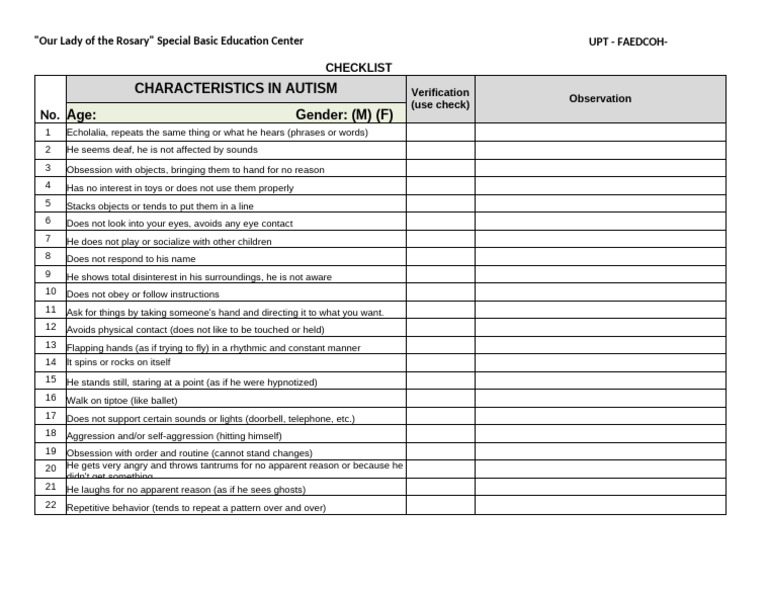
Repetitive behaviors and restrictive interests often present as hallmark features of autism. Checklists encapsulate these qualities by prompting parents to observe stereotyped movements such as hand flapping, rocking, or spinning objects. They also assess ritualistic behaviors—resistance to change, insistence on sameness, and adherence to routines.
Restricted interests might be characterized by an intense focus on singular topics or activities for extended periods. Identifying these patterns provides insight into sensory processing differences and supports the development of individualized sensory integration strategies or behavioral interventions.
Sensory Processing and Environmental Sensitivities
Many children on the spectrum exhibit heightened or diminished responses to sensory stimuli. An effective autism checklist will encompass an evaluation of sensitivities or atypical reactions related to sound, touch, taste, smell, and visual stimuli. It may also cover vestibular and proprioceptive challenges, such as balance issues or unusual motor coordination.
Parents are prompted to document any avoidance behaviors toward specific textures or environments, as well as unusual appetites or tactile explorations. Recognizing these sensory profiles is crucial. It informs environmental adaptations and therapies that not only enhance comfort but also improve the child’s functional participation in daily activities.

Behavioral Challenges and Meltdown Management
Behavioral challenges are often a manifestation of underlying communication frustrations or sensory overloads. Comprehensive checklists include sections on behavioral observations, enabling caregivers to document frequency, duration, and triggers of tantrums, meltdowns, or self-injurious behavior.
Such structured documentation assists in pinpointing antecedents and informs the creation of proactive strategies and behavioral intervention plans. Caregivers are often provided with insights into calming techniques and safety measures tailored for outdoor environments and garden play—spaces that offer both opportunity and risk for children with sensory processing differences.
Developmental Progress and Milestone Monitoring
Ultimately, autism checklists function as dynamic instruments for ongoing developmental surveillance. They incorporate periodic reassessments across cognitive, emotional, and adaptive skills. This feature enables parents and caregivers to track incremental gains or emerging challenges that may necessitate therapy adjustments or additional specialist input.
These milestones span academic preparedness, fine and gross motor coordination, self-help capabilities, and social adaptability. Through vigilant observation and record-keeping afforded by the checklist, caregivers can advocate effectively for individualized education plans (IEPs) or community support services, ensuring their child’s trajectory remains as positive and supported as possible.
Resource Guidance and Support Network Integration
In addition to symptom tracking, top-tier autism checklists frequently provide curated resource sections. These include links to downloadable PDFs, intervention guides, safety checklists specific to various environments, and strategies tailored to different ages. They also emphasize the importance of connecting families with local and national autism organizations, support groups, and multidisciplinary teams.
Access to these resources emboldens caregivers with current, research-based knowledge, fostering empowerment through education and community solidarity. The checklist thus becomes not just an assessment tool but also a navigational beacon through the complex landscape of autism care.
In summary, the ultimate autism checklist for parents and caregivers serves as a multidimensional guide to recognizing, understanding, and supporting autism spectrum disorder from infancy through adolescence. Its extensive scope covers behavioral, communicative, social, sensory, and developmental domains while providing practical strategies and resource connections. Engaging deeply with such a tool equips caregivers with the insights necessary to foster an environment where every child’s unique potential can flourish.