Social communication—the intricate dance of exchanging ideas, emotions, and intentions—can become an enigmatic terrain for many on the autism spectrum. Understanding the nuances embedded within this landscape not only redefines how we perceive autism but also illuminates a path toward empathy and empowerment. The challenges encountered in social communication are not mere deficits; they are signals of distinct neural wiring and offer profound insight into diverse ways of connecting with the world. What can truly be expected when navigating such challenges? The journey unfolds with complexity, subtlety, and a potential for growth beyond conventional paradigms.
Decoding the Spectrum of Social Communication Difficulties
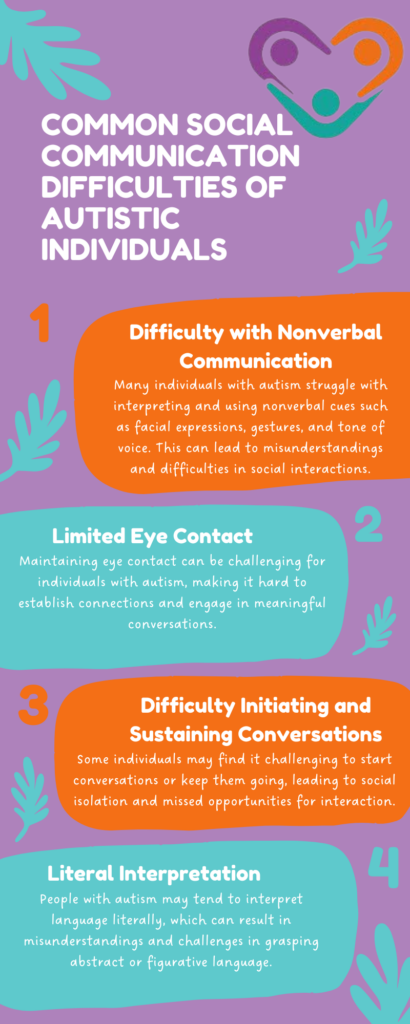
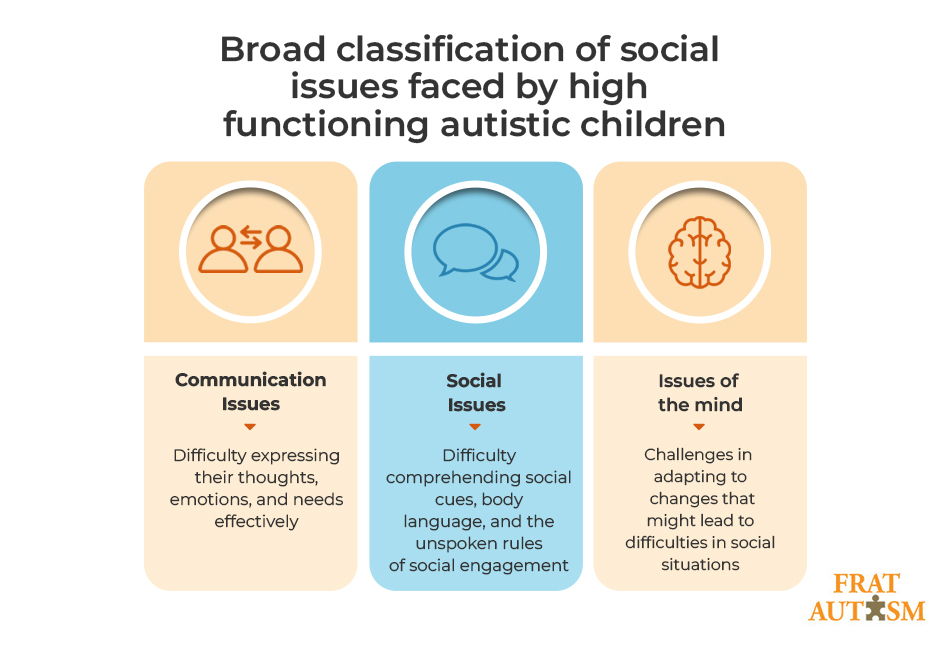
Autism spectrum disorder (ASD) is commonly associated with difficulty in social communication, but these difficulties manifest in multifaceted and highly individualized ways. For some, deciphering the implicit rules of conversation—such as turn-taking or recognizing tone and sarcasm—poses a significant challenge. Others may struggle with nonverbal cues like facial expressions, eye contact, or body language, which are vital for holistic understanding in social interactions.
These communicative nuances often lead to misunderstandings and inadvertent social withdrawal. The dissonance between intent and interpretation becomes glaring. For example, a child may not respond to their name or may fixate on a particular topic, behaviors often misunderstood as aloofness or disinterest. However, these patterns reflect an alternative mode of processing social stimuli rather than a lack of engagement.
The Enigmatic Role of Pragmatics in Social Interaction
Pragmatics—the study of how context influences language—plays a pivotal role in the social communication challenges faced by autistic individuals. The unspoken, the implied, and the conventional expectations embedded in everyday discourse can be elusive. For example, understanding irony or humor may require an advanced ability to infer beyond literal meanings, which can be particularly arduous.
Moreover, pragmatic impairments can lead to challenges in tailoring communication to fit social contexts. A child might speak with the formality of an academic presentation in a playground setting or may not pick up on social cues indicating that a topic is unwelcome. These pragmatic gaps create friction, often resulting in social exclusion or frustration.
High-Functioning Autism and the Hidden Struggles
High-functioning individuals on the spectrum often navigate a paradoxical landscape. Outwardly, they may exhibit fluent speech and apparent social ease, masking the intricate battles waged beneath the surface. Their challenges are often invisible yet pervasive, ranging from difficulty interpreting nuanced social cues to feeling overwhelmed by sensory inputs that influence communication.
These hidden struggles can manifest as anxiety, self-doubt, or social fatigue. A child labeled as “high-functioning” might still endure profound isolation because their communicative style does not align with neurotypical expectations. This disconnect underscores the importance of looking beyond superficial fluency and embracing complexity.
Beyond Words: The Significance of Nonverbal Communication
Communication transcends spoken language; it thrives in gestures, facial expressions, and eye gaze. For many autistic individuals, the mastery of these nonverbal signals is fraught with difficulty. A fleeting smile, a raised eyebrow, or even the appropriate use of pauses can carry nuanced meaning in social exchanges. Without the ability to interpret or use these cues effectively, interactions may feel disjointed or overwhelming.
Interestingly, some autistic individuals develop alternative forms of expressing emotions and thoughts—through art, music, or written communication—showcasing the diverse modalities of human connection. Appreciating these varied communication modes reshapes our understanding of what it means to truly engage socially.
Strategies That Illuminate the Path Forward
Effective interventions and supports are fundamental in mitigating social communication challenges. Empirically grounded strategies often emphasize structured social skills training, modeled interactions, and role-playing scenarios designed to foster pragmatic competencies. These methods anchor learning in predictability, reducing anxiety associated with ambiguous social norms.
Furthermore, inclusive educational environments that celebrate neurodiversity serve not only autistic individuals but also enrich the social fabric for all participants. Peer interactions, when scaffolded appropriately, become opportunities for mutual understanding and growth. The goal transcends mere normalization; it champions authentic connection and respect.

Reframing the Narrative: Embracing Neurodiversity
Perhaps the most transformative promise lies in recasting social communication challenges not as deficits to be corrected but as differences to be respected. This paradigm shift urges society to question entrenched assumptions about “normal” communication and to broaden its horizons.
The neurodiversity movement advocates for valuing diverse cognitive profiles and communicative styles, acknowledging that what may seem like a challenge in one context is a unique strength in another. By embracing these perspectives, we foster environments where autistic individuals can thrive, fully expressing themselves without the pressure to conform.
In essence, social communication challenges in autism compel us to reconsider the myriad ways humans connect and convey meaning. Far from a limitation, they invite introspection and expansion of our collective understanding. Learning to listen beyond words, to appreciate alternative modes of interaction, and to create inclusive spaces unlocks a richer, more empathetic social world for everyone.