Speech development is a fundamental aspect of early childhood growth, serving as a primary conduit for communication and social interaction. For children on the autism spectrum, however, speech delay often emerges as a significant concern, revealing itself in varied and complex manifestations. Parents confronted with this aspect of autism face myriad questions, uncertainties, and emotions as they navigate their child’s unique developmental trajectory. Understanding the nuances of autism-related speech delay equips caregivers with the insight necessary to advocate effectively and engage in targeted interventions that can transform outcomes.
Understanding Autism and Its Impact on Speech Development
Autism Spectrum Disorder (ASD) is characterized by a constellation of behaviors affecting communication, social interaction, and repetitive patterns of behavior. Speech delay within the context of autism diverges from typical speech delay primarily because it intertwines with social communication deficits rather than isolated linguistic processing issues. While some autistic children may develop spoken language later than their peers, others might display atypical speech patterns such as echolalia, pronoun reversal, or an unconventional prosody.
These nuances contribute to the phenomenon known as pragmatic language impairment, where the meaning and use of language in social contexts fall short of typical expectations. Recognizing these distinctive characteristics helps parents grasp why their child’s speech may not simply be delayed but qualitatively different.
Identifying the Signs of Speech Delay in Autism
Early identification is pivotal. Parents should observe not just the chronological emergence of speech but also the contextual and functional use of language. Typical speech milestones such as babbling by six months, first words by twelve months, and simple phrases by eighteen to twenty-four months might be noticeably absent or delayed. However, in autism, additional signs including limited eye contact during communication, reduced responsiveness to social cues, or repetitive vocalizations can intensify the speech delay diagnosis.
Furthermore, a child exhibiting minimal gestural communication—like pointing or waving—and lacking joint attention may signal underlying social communication challenges. Such behavioral markers often precede or accompany speech delay, underscoring the intricate interplay between language and social engagement in autism.
The Spectrum of Speech Patterns in Children with Autism
Speech delay in autism presents itself along a continuum, ranging from nonverbalism to the presence of complex verbal skills tinged with pragmatic impairments. Some children remain nonverbal, relying heavily on alternative communication methods. Others may exhibit echolalia, either immediate or delayed, repeating words or phrases without apparent communicative intent. This can be perplexing to parents, who may struggle to interpret whether such repetitive speech conveys meaning or serves a self-stimulatory purpose.
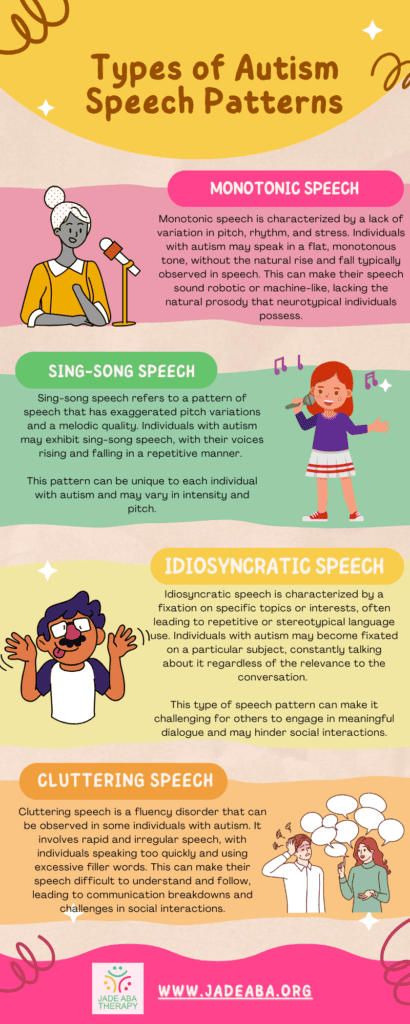
Another common phenomenon is “scripted speech,” where children recite lines from movies or favorite shows instead of producing original utterances. Prosodic elements—like monotone delivery or unusual pitch and rhythm—can further distinguish speech patterns in autism. These features highlight the necessity of individualized assessments and tailored therapeutic approaches.
Speech Therapy Interventions: Tailoring Approaches to Individual Needs
Intervention strategies must meticulously align with each child’s unique profile. Speech therapy, often facilitated by licensed Speech-Language Pathologists (SLPs), remains the cornerstone of treatment for speech delay associated with autism. These professionals deploy an array of specialized techniques designed to enhance expressive and receptive language abilities, pragmatic skills, and nonverbal communication.
For children exhibiting limited verbal output, augmentative and alternative communication (AAC) devices—such as picture exchange communication systems (PECS) or speech-generating devices—offer vital pathways to expression. Therapists also utilize behavioral strategies rooted in Applied Behavior Analysis (ABA) to reinforce communication attempts and reduce maladaptive behaviors impeding speech development.
Parents engaging in consistent home-based exercises and collaborative goal setting with therapists often witness the most robust progress. This combinatory approach magnifies gains by ensuring speech practice is both systematic and contextually meaningful.
Challenges and Emotional Dimensions for Parents
The journey through autism-related speech delay is seldom linear, and parents frequently confront emotional upheavals alongside practical challenges. Feelings of frustration, helplessness, and anxiety are common as caregivers reconcile hope with the realities of their child’s pace and style of communication. Navigating a labyrinth of services, deciphering complex terminologies, and advocating within educational systems can add layers of stress.
It is crucial for parents to acknowledge these emotional demands and seek supportive networks, whether through counseling, parent advocacy groups, or peer connections. Empowerment through knowledge, self-care, and community engagement often fosters resilience and a more proactive posture in their child’s developmental journey.
Supporting Social Communication Beyond Speech
Language is only one facet of communication; nonverbal cues such as gestures, facial expressions, and body language play indispensable roles. Children with autism may display impairments in interpreting or employing these cues, compounding their communicative difficulties. Interventions designed to build joint attention, social reciprocity, and symbolic play significantly complement speech therapy efforts.
Implementing social stories, role-playing scenarios, and community-based experiences creates enriched environments for practicing these skills organically. Parents who weave communication opportunities into daily routines often catalyze spontaneous verbal and nonverbal interactions.

When to Seek Professional Evaluation
Prompt professional evaluation is essential when parents observe persistent speech delays or regressions, lack of social interaction, or other atypical communicative behaviors. A multidisciplinary assessment typically includes developmental pediatricians, audiologists, psychologists, and SLPs, who collectively ascertain the child’s strengths and challenges.
Early diagnosis and intervention correlate strongly with more favorable prognoses. Therefore, trust in professional guidance and proactive advocacy become critical components of fostering a child’s communicative potential.
In conclusion, navigating the complexities of autism and speech delay demands a well-rounded understanding of the diverse manifestations and multifaceted interventions available. Knowledge empowers parents not only to recognize subtle signs early but also to implement strategies that nurture communication in all its forms. Through perseverance, collaboration with professionals, and unwavering support, children with autism can progress toward meaningful expression and enriched social participation, illuminating pathways to a more connected future.