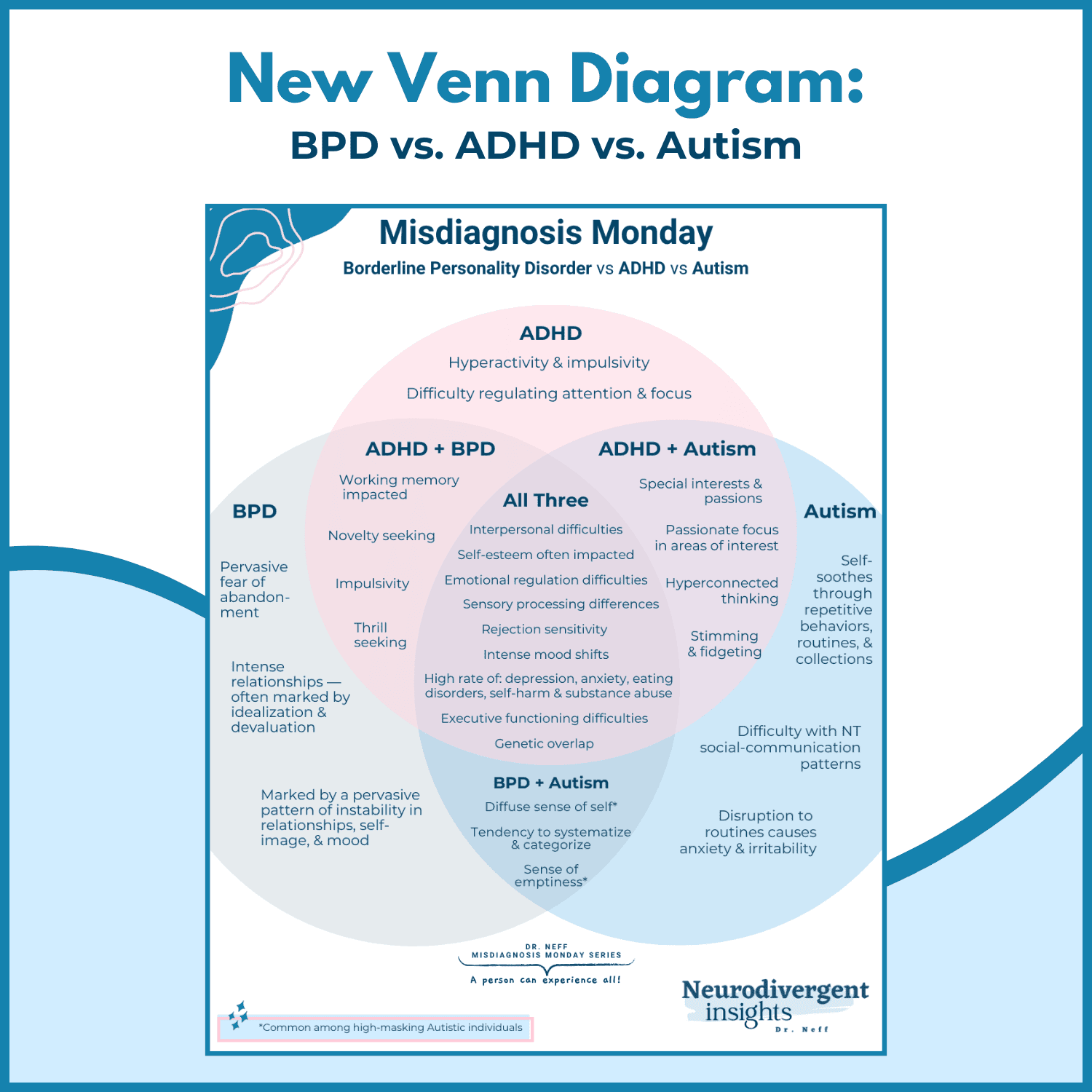
The human mind is a labyrinth of mirrored corridors, where echoes of one experience reverberate in another, often without invitation. Within this intricate maze, two conditions—Autism Spectrum Disorder (ASD) and Borderline Personality Disorder (BPD)—stand as towering pillars, their shadows stretching across the emotional and cognitive landscapes of millions. Though classified separately in diagnostic manuals, their paths frequently intersect, blurring the lines between identity and disorder, stability and storm. To understand their overlaps is to peer into the paradox of human difference: where sameness and singularity dance in uneasy harmony. This exploration is not merely clinical—it is a journey into the heart of what it means to feel, to connect, and to be misunderstood.
Imagine the mind as a vast ocean. In ASD, the waters are often still, crystal-clear, revealing the intricate patterns of thought beneath the surface—patterns that others may never see. In BPD, the tides are relentless, pulling emotions into whirlpools of intensity, where identity dissolves and reforms with each passing wave. Yet, in some minds, both landscapes coexist: the clarity of structure meeting the chaos of emotion, creating a terrain both uniquely challenging and profoundly human.
The Labyrinth of Emotional Regulation: Where Storms Meet Stillness
At the core of both ASD and BPD lies a struggle with emotional regulation, but the nature of that struggle diverges like two rivers carving separate canyons. In BPD, emotions are not merely felt—they are experienced as tidal forces, overwhelming and unpredictable. A discarded text, a fleeting glance, a misplaced word—each becomes a catalyst for emotional earthquakes. The individual oscillates between extremes: adoration and contempt, presence and absence, love and annihilation. It is as though the emotional thermostat has been replaced with a live wire, sparking uncontrollably at the slightest touch.
In contrast, individuals with ASD often experience emotions with a muted intensity, as if viewing the world through a veil of glass. Their emotional responses may be delayed or muted, not because they feel less, but because the pathways to expression are less direct. Yet, when emotions do surface, they can be profound—like the sudden eruption of a geyser in an otherwise tranquil landscape. The challenge here is not volatility, but clarity: the inability to modulate reactions in a world that demands immediate, socially calibrated responses.
When these two worlds collide, the result is a paradoxical dance. The person with co-occurring ASD and BPD may find themselves caught between the stillness of their own thoughts and the tempest of external expectations. They may crave connection yet recoil from its unpredictability. They may long for emotional expression but fear its intensity. It is a duality that defies simple categorization—a mind that is both fortress and open sea.

The Mirror of Identity: Fragmentation and Fixation
Identity, that elusive construct we cling to as proof of our existence, becomes a battleground in both conditions. In BPD, identity is fluid, almost liquid—shifting with each interaction, each perceived rejection, each fleeting moment of connection. The individual may describe themselves as a chameleon, adapting not out of malice, but out of a desperate need to belong. Yet, this adaptability comes at a cost: the erosion of a stable sense of self. It is as though they are perpetually sculpting their identity from clay that never hardens.
In ASD, identity is often rigid, defined by routines, special interests, and unyielding self-perceptions. The individual may resist change not out of defiance, but because change disrupts the fragile architecture of their inner world. They may identify so strongly with their interests that they become extensions of themselves—like constellations in a personal sky. Yet, this rigidity can also be a source of strength: a steadfast anchor in a sea of chaos.
When these two forces converge, the result is a mind that is both hyper-aware and hyper-dissociated. The individual may fixate on certain aspects of their identity while simultaneously feeling as though they are watching themselves from outside their body. They may crave consistency yet be drawn to the drama of instability. It is a push-and-pull between the desire for wholeness and the fear of being trapped in a version of oneself that feels inauthentic.
The Social Paradox: Longing and Alienation
Human connection is a double-edged sword, and nowhere is this more evident than in the social experiences of those with ASD and BPD. In BPD, the longing for connection is often accompanied by a deep-seated fear of abandonment. Every interaction is scrutinized for signs of rejection, and every perceived slight becomes a wound. It is as though the individual is standing on the edge of a cliff, yearning to leap into the arms of another, yet terrified of the fall.
In ASD, social challenges stem not from fear, but from a fundamental difference in how social cues are processed. The individual may struggle to read facial expressions, tone of voice, or body language—not because they lack empathy, but because these signals are as foreign as a language they never learned. They may crave connection but lack the tools to navigate its complexities. It is like being handed a map with no legend, unable to decipher the symbols that guide others.
When both conditions are present, the social landscape becomes a minefield of misinterpretations and missed cues. The individual may oscillate between withdrawal and clinginess, between over-analysis and emotional numbness. They may crave deep, meaningful relationships yet sabotage them out of fear or misunderstanding. It is a cycle that can feel inescapable—a prison built from the bricks of human connection.
The Cognitive Kaleidoscope: Patterns and Paradoxes
The mind of someone with co-occurring ASD and BPD is a kaleidoscope of shifting patterns, where thoughts and emotions twist and turn in unpredictable ways. In ASD, the mind often operates in a linear, detail-oriented fashion, with a preference for order and predictability. The individual may excel in areas that require precision and pattern recognition, their thoughts moving like a metronome—steady, methodical, unyielding.
In BPD, the mind is more like a storm system—chaotic, dynamic, and driven by external stimuli. Thoughts may race unpredictably, jumping from one idea to the next in a frenetic dance. The individual may struggle with executive function, their attention scattered like leaves in the wind. Yet, this chaos can also be a source of creativity, a wellspring of ideas that defy conventional logic.
When these two cognitive styles merge, the result is a mind that is both hyper-focused and hyper-distracted. The individual may become deeply engrossed in a special interest, only to be derailed by an emotional trigger. They may excel in tasks that require attention to detail, yet struggle with tasks that demand emotional flexibility. It is a paradox that defies easy explanation—a mind that is both a masterpiece and a puzzle.
The Path Forward: Embracing the Paradox
To live with co-occurring ASD and BPD is to navigate a landscape that is both familiar and foreign, a place where the rules of engagement are constantly rewritten. Yet, within this complexity lies a profound truth: these conditions do not define the individual. They are merely facets of a larger, more intricate whole. The key to thriving lies not in erasing the paradox, but in learning to dance with it.
Therapy, particularly approaches like Dialectical Behavior Therapy (DBT) and Cognitive Behavioral Therapy (CBT), can provide tools to navigate the emotional storms and cognitive patterns that define these conditions. Support groups and communities of neurodivergent individuals offer a space where experiences can be shared without judgment. And perhaps most importantly, self-compassion becomes the compass that guides the way.
The journey is not one of resolution, but of acceptance. It is the acceptance that emotions can be both overwhelming and underwhelming. It is the acceptance that identity can be both fluid and fixed. It is the acceptance that connection can be both a lifeline and a trigger. In embracing the paradox, the individual finds not just understanding, but a unique way of being in the world—one that is as valid as any other.
The labyrinth is not a prison. It is a landscape. And within its winding paths lies the potential for transformation—a metamorphosis not into something else, but into something more.